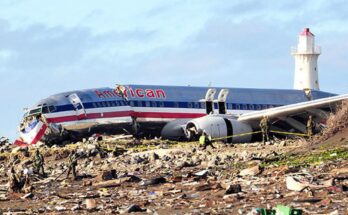
On November 7, 2018, a Sky Lease Cargo Boeing 747-412F, registered as N908AR, was involved in a serious runway overrun at Halifax Stanfield International Airport in Nova Scotia, Canada. The enormous four-engine cargo aircraft was operating as Sky Lease Cargo Flight 4854 (KYE4854), on a positioning flight from Chicago O’Hare International Airport to Halifax. Although the accident looked potentially catastrophic, all four people aboard survived, with only minor injuries reported. The aircraft, however, was so severely damaged that it was classified as a hull loss and was never returned to service. (Transportation Safety Board of Canada)
The Aircraft and the Flight
N908AR was a Boeing 747-412F, a freighter version of the iconic Boeing 747. Its serial number was 28026. Unlike a passenger 747, the aircraft was configured to transport freight rather than a large number of passengers.
The flight involved in the accident was not carrying a commercial cargo load. According to the Transportation Safety Board of Canada (TSB), the aircraft was flying from Chicago O’Hare to Halifax as the first leg of a longer multi-leg operation. The aircraft was scheduled to pick up cargo at Halifax before continuing to Anchorage, Alaska, and eventually to Changsha, China. (Transportation Safety Board of Canada)
There were four people aboard: three operating crew members and one additional crew member traveling in a positioning capacity. No cargo was on board at the time of the accident. (Transportation Safety Board of Canada)
The flight itself began normally. The crew prepared the aircraft for the arrival into Halifax during the early morning hours. However, weather, runway conditions, aircraft performance calculations, and several cockpit events would combine to produce a dangerous situation during the final stages of the flight.

The Approach to Halifax
The Boeing 747 was approaching Halifax during darkness. The crew conducted an instrument landing system approach toward Runway 14.
One of the important factors in the accident was wind. During the approach, the crew became aware that they were experiencing a tailwind. The TSB found that the crew recognized the tailwind approximately one minute and 21 seconds before reaching the runway threshold. However, they did not recalculate the aircraft’s landing performance at that point to confirm whether the available runway distance remained acceptable. (Transportation Safety Board of Canada)
The tailwind increased the aircraft’s required landing distance. While the resulting distance requirement did not, by itself, exceed the runway length, it reduced the available safety margin.
This became particularly important because the aircraft was a large and heavy Boeing 747. A 747 requires significant runway distance to decelerate after touchdown, especially when the runway is wet and the aircraft lands at a higher-than-ideal speed.
The TSB investigation identified several factors that ultimately contributed to the runway overrun, rather than a single isolated mistake. These included the tailwind, landing-performance considerations, the aircraft’s touchdown characteristics, braking, and events involving the thrust levers and speed brakes. (Skybrary)
A Firm Touchdown
At approximately 05:06 Atlantic Standard Time, the Boeing 747 touched down on Runway 14.
The touchdown was firm. The aircraft also had a right crab angle of approximately 4.5 degrees when it initially touched down. At that point, the crew faced the critical task of getting the aircraft slowed and stopped within the remaining runway distance. (TSB)
A major problem then occurred.
According to the TSB investigation, after the firm touchdown, the No. 1 engine thrust lever was moved forward of the idle position for reasons the investigation could not definitively determine. This caused the aircraft’s speed brakes to retract and the autobrake system to disengage. Both systems were important to rapidly reducing the aircraft’s speed after landing. (TSB)
With the speed brakes no longer deployed and the autobrakes disengaged, the aircraft did not decelerate as effectively as it otherwise could have.
The 747 continued racing down the runway.

The Runway Overrun
The aircraft was unable to stop before reaching the end of Runway 14.
Instead, N908AR continued beyond the runway and entered the area beyond the paved surface. The aircraft traveled approximately 270 metres beyond the runway end before coming to a stop. (Skybrary)
The accident occurred in darkness, adding another challenge to an already difficult situation.
The aircraft went down an embankment and struck airport infrastructure, including the localizer antenna associated with the runway system. Various runway and approach lighting equipment was also damaged or destroyed. (Skybrary)
Despite the size and weight of the aircraft, the Boeing 747 ultimately came to rest without breaking apart in a catastrophic manner.
That fact was crucial for the survival of everyone aboard.
Severe Damage to the 747
Although there were no fatalities, N908AR suffered devastating structural and mechanical damage.
The landing gear collapsed, while multiple engines were damaged. Reports based on the investigation describe engines No. 2 and No. 3 separating from the aircraft, while engines No. 1 and No. 4 were also damaged. The aircraft’s fuselage sustained significant damage as well. (Airportia)
The damage was beyond economical and practical repair. The TSB ultimately classified the aircraft as a hull loss. In aviation terminology, this means the aircraft was damaged to such an extent that it was not returned to service. (Skybrary)
In other words, the accident effectively marked the end of N908AR’s flying career.
For an aircraft as large and valuable as a Boeing 747 freighter, seeing it destroyed during what was supposed to be a routine positioning flight demonstrated how quickly a landing accident can escalate.
How Did the Aircraft Fail to Stop?
The accident was not caused by one simple factor.
The TSB’s investigation identified a combination of operational and human factors. One important issue was the use of landing-performance information that did not fully account for the conditions encountered during the approach.
The unexpected tailwind increased the required stopping distance. The crew recognized the tailwind relatively late in the approach, leaving limited time to reassess the landing performance. (Transportation Safety Board of Canada)

The runway was also wet, which reduced braking effectiveness compared with a dry runway.
Another important factor was what happened immediately after touchdown. The movement of the No. 1 thrust lever caused the speed brakes to retract and the autobrake system to disengage. This significantly affected the aircraft’s ability to slow down. (TSB)
The crew also had to deal with the aircraft’s lateral position following touchdown. The TSB found that the pilot’s actions and attention during the landing sequence contributed to the overall situation.
The investigation therefore treated the accident as a chain of events rather than simply blaming one individual.
The Importance of Runway Selection
Another interesting aspect of the investigation involved runway availability information.
The longer and more suitable Runway 25 was not selected for the landing. The investigation found that the presentation of NOTAM information contributed to the crew’s understanding that Runway 25 was unavailable. (Skybrary)
This was significant because runway length can make an enormous difference when operating a large aircraft.
A longer runway provides more distance for an aircraft to correct an unstable situation, compensate for wind, and reduce speed before reaching the runway end.
The accident therefore highlighted how seemingly small information-management issues can become important when combined with changing weather and aircraft-performance factors.
The Emergency Response
Once the aircraft overran the runway, emergency services responded to the scene.
The airport environment was affected by the accident, with infrastructure damaged beyond the runway end. The aircraft itself was clearly heavily damaged, and the collapsed landing gear and damaged engines made it impossible to simply tow the 747 away as though it had suffered a minor incident.
Fortunately, the four occupants survived.
Their survival was one of the most important aspects of the accident. A Boeing 747 leaving the runway at high speed and traveling hundreds of metres beyond the pavement could have resulted in a much greater loss of life.
Instead, the accident became a major aviation safety investigation rather than a fatal disaster.
The Investigation
The Transportation Safety Board of Canada conducted a detailed investigation into the accident under investigation number A18A0085.
Investigators examined the aircraft, runway, weather conditions, flight data, cockpit voice recordings, air traffic control information, and other evidence. The TSB published its final report in June 2021. (Transportation Safety Board of Canada)
The investigation found that the accident resulted from a combination of factors.
These included the late recognition of the tailwind, the landing-performance assessment, the aircraft’s touchdown characteristics, the movement of the thrust lever, loss of speed-brake and autobrake effectiveness, braking performance, and other cockpit workload and human-factors issues. (Skybrary)
The investigation also examined the information available to the crew regarding runway availability.
This is important because modern aviation accidents rarely have a single cause. Instead, several relatively manageable problems can line up at exactly the wrong moment.
A Valuable Aviation Safety Lesson
The destruction of N908AR provides an important lesson about the final seconds of a flight.
Landing is often considered one of the most routine phases of aviation, but it is also one of the phases where many factors can rapidly change. Wind direction, runway surface condition, airspeed, touchdown point, aircraft configuration, braking systems, and pilot workload all influence the outcome.
A large aircraft can be perfectly controllable in the air but still face serious danger if it touches down with insufficient stopping margin.
The Halifax accident demonstrated why pilots must continuously reassess landing conditions and maintain a conservative approach when circumstances change.
It also demonstrated the importance of having effective communication between flight crews, air traffic controllers, airport authorities, and other organizations responsible for providing operational information.
No Fatalities, but a Total Aircraft Loss
Perhaps the most remarkable fact about the accident is the contrast between the condition of the aircraft and the outcome for the people aboard.
N908AR was essentially destroyed as an operational aircraft. Its landing gear collapsed, several engines were severely damaged or separated, and the fuselage sustained major damage. Yet all four occupants survived. (Skybrary)
That outcome illustrates the strength of the Boeing 747’s structure and the effectiveness of emergency response systems.
It also serves as a reminder that aircraft accidents should not be judged solely by the condition of the aircraft. An airplane can be completely written off while everyone aboard survives.
In this case, the financial and operational loss was substantial, but the human consequences were comparatively limited.
The Final Chapter of N908AR
Before the Halifax accident, N908AR had already accumulated many years of service. As a Boeing 747 freighter, it represented one of the most recognizable aircraft types in commercial aviation.
The accident at Halifax brought that career to an abrupt end.
Instead of continuing to Anchorage and eventually China as planned, the aircraft ended its journey in the grass and airport infrastructure beyond Runway 14.
What had started as a routine positioning flight from Chicago became one of the more memorable Boeing 747 runway accidents in Canada.
The aircraft never flew again.
Conclusion
The Sky Lease Cargo Boeing 747-400F N908AR accident at Halifax was a dramatic example of how several relatively small factors can combine into a serious aviation accident.
On November 7, 2018, the aircraft arrived at Halifax during darkness and approached Runway 14. The crew became aware of a tailwind shortly before landing but did not recalculate the landing performance. The aircraft then touched down firmly on the wet runway. Shortly afterward, the No. 1 thrust lever moved forward, resulting in the retraction of the speed brakes and disengagement of the autobrake system. (Transportation Safety Board of Canada)
The 747 could not stop before the end of the runway. It overran by roughly 270 metres, traveled beyond the paved surface, and struck airport infrastructure. The resulting damage was severe enough for the aircraft to be classified as a hull loss. (Skybrary)
Yet the most important outcome was that all four occupants survived.
The destruction of N908AR was a major loss for its operator, but the accident provided valuable lessons about landing performance, tailwinds, braking systems, runway information, cockpit workload, and the importance of maintaining adequate safety margins.
The Halifax accident ultimately demonstrated one of the fundamental principles of aviation safety: a safe landing is not simply about touching down on the runway—it is about having enough control, distance, and performance remaining to come to a complete stop.