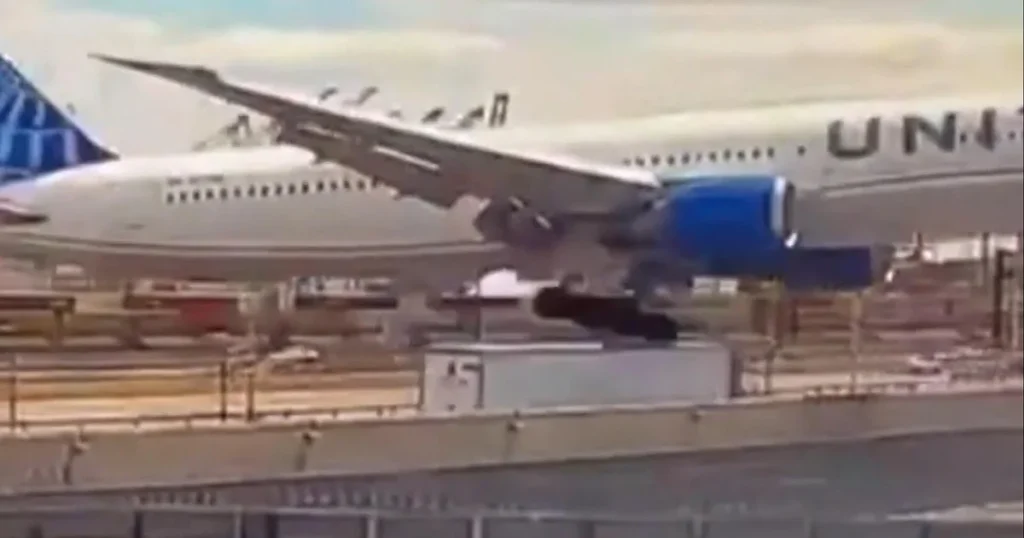
A routine international flight into New Jersey turned into a frightening aviation incident on May 3, 2026, when United Airlines Flight 169 came dangerously close to the New Jersey Turnpike during its final approach to Newark Liberty International Airport. The Boeing 767, arriving from Venice, Italy, struck a light pole positioned above the highway. The collision caused debris to fall onto a passing bakery truck and injured its driver. Despite the dramatic encounter, the aircraft continued its approach and landed safely at Newark. None of the 221 passengers or 10 crew members aboard the aircraft were injured. (ABC7 San Francisco)
The incident immediately attracted national attention because video from the roadway showed just how close the large passenger jet came to vehicles traveling on the busy highway. The footage captured the aircraft descending toward the airport while traffic continued below. Moments later, the airplane’s landing gear or lower structure contacted a light pole, creating a dangerous chain of events on the roadway.
The event was initially described in some reports as the aircraft striking both the light pole and a truck. However, later preliminary findings from the National Transportation Safety Board provided a more precise explanation. According to the NTSB, the airplane struck the light pole while passing extremely low over the New Jersey Turnpike, and the pole, rather than the airplane itself, struck the truck. The bakery truck was damaged and its driver suffered minor injuries. (ABC News)
The Flight From Venice to Newark
United Flight 169 was operating a scheduled international service from Venice Marco Polo Airport in Italy to Newark Liberty International Airport in New Jersey. The aircraft was a Boeing 767-400, a wide-body twin-engine jet commonly used for long-distance international operations.
There were 231 people aboard the aircraft: 221 passengers and 10 members of the crew. The flight had completed most of its journey without incident. The critical part of the flight began during the approach into Newark, when changing wind conditions resulted in several runway changes.
Newark is a major international gateway serving the New York metropolitan area. Its runways are surrounded by a complicated mixture of airport infrastructure, highways, industrial areas and densely developed transportation corridors. The New Jersey Turnpike runs beneath portions of the approach path, making precise aircraft control particularly important during low-altitude approaches.
Flight 169 was eventually cleared toward Runway 29. The approach was unusual for the flight because the pilots had initially expected to use another runway before being reassigned. According to the NTSB’s preliminary findings, the aircraft was first expected to land on Runway 4R, then was switched to Runway 22L, and finally assigned Runway 29. (ABC News)

A Difficult Approach
Weather conditions were an important part of the developing investigation. The NTSB reported that winds were gusting at approximately 30 knots during the approach. Gusty winds can make the final stages of a landing more demanding because pilots must constantly adjust pitch, power and flight path to maintain the correct approach profile.
The captain was manually flying the Boeing 767 rather than using the autopilot during the final approach. The first officer was monitoring the flight and providing standard callouts concerning airspeed and altitude.
The NTSB reported that the first officer warned the captain on two occasions that the aircraft was slow. During the second warning, the first officer also indicated that the aircraft was low. The pilots corrected the flight path after the first warning, and the aircraft returned toward the appropriate speed. However, moments later, its airspeed decreased again as it continued toward the runway. (ABC News)
One of the most important details revealed by investigators was the aircraft’s exceptionally low altitude over the highway.
The NTSB determined that Flight 169 was only about 15 feet above the New Jersey Turnpike when it contacted the light pole. At that point, the airplane was already extremely close to the runway and was in the final seconds before touchdown. (ABC News)
For motorists on the highway, an approaching Boeing 767 would have appeared enormous and alarmingly close. The aircraft’s landing gear was extended, and the airplane was moving at high speed relative to the vehicles below.
The Moment of Impact
As the aircraft crossed over the turnpike, its left side came into contact with the light pole. The collision caused damage to the aircraft and the pole.
The falling or displaced pole then struck a bakery tractor-trailer traveling on the highway. The truck’s cab sustained damage, including damage to its windshield. The driver suffered minor injuries and was transported to a hospital. He was later released. (ABC7 San Francisco)
The incident could have produced a far more serious outcome. The New Jersey Turnpike is a heavily traveled roadway, and a large object falling onto traffic from an aircraft could potentially cause a major multi-vehicle accident.
Instead, the damage was limited primarily to the light pole, the truck and the aircraft. The truck driver was the only person known to have been injured.
Inside the aircraft, the pilots and passengers experienced the collision as a noticeable impact. According to the NTSB’s preliminary account, the pilots felt a thump shortly before touchdown.
The airplane nevertheless remained controllable. The crew completed the landing and taxied to the gate normally. Only after the aircraft reached the gate did the full extent of the damage become apparent.
The Truck Driver’s Perspective
The bakery truck involved in the incident was traveling on the New Jersey Turnpike while carrying bakery products toward the Newark area.
The driver could not reasonably have expected an approaching passenger aircraft to come into contact with infrastructure directly above the highway. From the roadway, aircraft landing at Newark can appear surprisingly low because the highway passes directly beneath approach paths.
Dashcam video from the truck provided investigators and the public with an extraordinary view of the event. The footage showed the aircraft approaching from above while the truck continued along the highway.
The sudden impact damaged the truck and shattered glass. The driver’s injuries were described as minor, but the situation could easily have been much worse.
A vehicle traveling at highway speed has almost no opportunity to react to an object falling from above. The driver was essentially in the wrong place at the wrong moment.
The survival of the truck driver, passengers and crew prevented the incident from becoming a major aviation disaster.

What Happened to the Aircraft?
The Boeing 767 sustained damage during the encounter. United Airlines said its maintenance team would evaluate the aircraft and investigate the circumstances surrounding the incident.
Despite the damage, the aircraft remained capable of completing its landing. It taxied to the gate normally rather than stopping on the runway or requiring emergency assistance. No passenger or crew evacuation was necessary.
The aircraft’s safe landing was especially significant because damage to landing gear or the lower fuselage during the final seconds of flight can create serious risks. A damaged landing gear assembly can potentially affect braking, steering or the ability of an aircraft to remain stable during touchdown.
In this case, however, the aircraft touched down successfully and remained under control.
The incident demonstrates how quickly an aircraft can transition from a seemingly normal approach into a potentially dangerous situation. At low altitude, pilots have very little time to recognize a problem, diagnose it and decide whether to continue the landing or execute a go-around.
Investigation by the NTSB and FAA
The National Transportation Safety Board launched an investigation into the incident. Federal aviation authorities also became involved.
Investigators examined the aircraft, the light pole, roadway evidence and available flight data. They also interviewed members of the flight crew and examined air traffic control information.
The purpose of the investigation is not simply to determine what physically struck the pole. Investigators must establish why the aircraft descended to such a low altitude and whether multiple factors contributed.
These factors can include weather, runway changes, aircraft configuration, airspeed, vertical descent rate, crew coordination, air traffic control instructions and the overall approach procedure.
The NTSB’s preliminary findings showed that the pilots had received several runway changes during the approach. Investigators also documented the first officer’s warnings that the aircraft was slow and low. (ABC News)
The first officer reportedly looked outside the cockpit shortly before touchdown and recalled thinking that the aircraft appeared too low. However, the situation developed so quickly that a go-around warning was not initiated in time. (ABC News)
These details will likely be important in determining how the aircraft ended up so close to the roadway.
The Importance of Runway 29
Runway 29 at Newark has attracted attention because of its location relative to the New Jersey Turnpike.
Aircraft approaching the runway pass over the highway at relatively low altitude. Under normal conditions, this is not inherently unsafe. Airport approach procedures are designed to ensure that aircraft maintain adequate clearance from obstacles and terrain.
However, the incident demonstrated how narrow the margin can become if an aircraft is lower than expected during the final approach.
The combination of a low approach, an aircraft with landing gear extended, roadway traffic and fixed infrastructure created an unusual chain of circumstances.
A Boeing 767 is a large aircraft with a wingspan of more than 150 feet. Even when traveling at landing speed, its size means that an error of only a few feet in vertical clearance can have serious consequences when obstacles are nearby.
Wind and Pilot Workload
Strong and gusty winds can complicate any landing, particularly when an aircraft is transitioning between runways and approach procedures.
The NTSB reported winds of approximately 30 knots during the Flight 169 approach. The aircraft was also being manually flown, requiring the captain to make continuous corrections.
The pilot must simultaneously maintain airspeed, altitude, descent rate, alignment with the runway and proper aircraft configuration. The first officer monitors these parameters and provides callouts when something begins to move outside the desired range.
The cockpit crew also has to communicate with air traffic control and respond to changing clearances.
None of these factors alone necessarily explains the incident. Investigators will need to determine how they interacted.

Why a Go-Around Matters
One of the fundamental safety procedures in aviation is the go-around.
If an approach becomes unstable or the aircraft is too high, too low, too fast, too slow or improperly aligned, pilots can abandon the landing and climb away for another attempt.
A go-around is not considered a failure. It is a standard safety procedure used whenever a landing cannot be completed safely.
In the Flight 169 incident, the NTSB’s preliminary findings indicated that the first officer recognized the aircraft was low. However, the final seconds of the approach passed quickly, and the aircraft continued toward the runway.
Understanding why the crew did not initiate a go-around earlier will be an important part of the investigation.
Investigators will likely examine cockpit recordings, flight data and the timing of crew communications to determine exactly what the pilots knew and when they knew it.
A Narrow Escape
Perhaps the most remarkable aspect of the incident is that everyone aboard the aircraft survived without injury.
A Boeing 767 carrying hundreds of people came extremely close to a busy highway, contacted infrastructure and still completed a normal landing.
The truck driver was injured, but his injuries were not life-threatening. Other motorists were not seriously hurt.
The incident therefore represents a dramatic near-disaster rather than a mass-casualty aviation accident.
Video footage made the event particularly striking. People watching the footage could see how close the aircraft was to the highway and understand why the incident immediately raised questions about approach altitude and obstacle clearance.
United Airlines’ Response
United Airlines confirmed that Flight 169 came into contact with a light pole during its final approach and said that the aircraft landed safely.
The airline stated that its maintenance team would evaluate the aircraft and that the circumstances would be investigated. The pilots were removed from service during the investigation process. (ABC7 San Francisco)
Removing crew members from active flying while an investigation is underway is a precautionary step that allows investigators and the airline to review the circumstances without assuming responsibility before the facts are established.
It is important to distinguish preliminary findings from a final determination. Aviation investigations can take considerable time because investigators examine technical data, human factors, operational procedures and environmental conditions before reaching conclusions.
Lessons for Aviation Safety
The Flight 169 incident offers several important safety lessons.
First, stabilized approaches are critical. An aircraft must remain within appropriate limits for speed, altitude, descent rate and alignment during the final approach.
Second, clear communication between pilots is essential. The first officer’s warnings about airspeed and altitude demonstrate the importance of cockpit monitoring.
Third, runway changes can increase workload. Pilots must rapidly transition from one approach procedure to another while maintaining situational awareness.
Fourth, weather conditions can significantly affect aircraft handling. Gusty winds require continuous corrections and careful monitoring.
Finally, go-arounds remain one of aviation’s most important safety tools. When an approach becomes unsafe, abandoning the landing can provide the additional time and altitude needed to regain control of the situation.

What Investigators Will Continue to Examine
The preliminary NTSB findings provide a clearer picture of the event, but they do not necessarily represent the final explanation.
Investigators are expected to examine the aircraft’s flight data, cockpit voice recordings, air traffic control communications, weather conditions, runway assignments and the physical evidence from the aircraft and roadway.
They will also analyze the exact flight path of the Boeing 767 and determine how its altitude changed during the final portion of the approach.
Investigators will want to understand why the aircraft descended to approximately 15 feet above the highway and whether the aircraft’s position was affected by wind, runway changes, flight crew workload or other factors.
They will also study the damage to the airplane and determine precisely how the landing gear and light pole interacted.
The distinction between the airplane striking the truck and the light pole striking the truck is particularly important. Early reports were based partly on dramatic video and eyewitness observations, while the NTSB’s later preliminary findings provided a more detailed account.
That evolution illustrates why aviation investigations require patience. Initial reports can change as investigators gather physical evidence and reconstruct the event.
The Broader Significance
The Flight 169 incident is likely to remain an important case study in aviation safety because it combined several unusual circumstances in one event.
A large international passenger aircraft was operating a normal arrival into one of the busiest airports in the United States. Changing winds and runway assignments created a demanding approach. The aircraft became extremely low over a major highway and struck a light pole.
The resulting debris damaged a commercial truck and injured its driver.
Yet the aircraft remained controllable, landed safely and brought all passengers and crew to the gate.
For aviation professionals, such an event provides an opportunity to identify weaknesses before a similar situation produces a more serious accident.
For the traveling public, it is a reminder that airline safety depends on many layers working together: trained crews, air traffic controllers, approach procedures, airport infrastructure, weather information, aircraft systems and strict operational standards.
Conclusion
United Flight 169’s encounter with a light pole during its landing approach at Newark Liberty International Airport was a frightening event that could have ended very differently.
The Boeing 767 was carrying 231 people from Venice to New Jersey when it descended exceptionally low over the New Jersey Turnpike. It struck a light pole shortly before landing, and the pole damaged a passing bakery truck. The truck driver suffered minor injuries, while everyone aboard the aircraft escaped unharmed. (ABC7 San Francisco)
The aircraft ultimately landed safely and taxied to the gate, but the incident prompted investigations by aviation authorities.
Preliminary findings have already highlighted several important factors, including gusty winds, multiple runway changes, manual flight during the approach, warnings about the aircraft being slow and low, and the extremely small clearance between the airplane and the highway. (ABC News)
The final investigation will determine exactly how these factors came together.
For now, Flight 169 stands as a powerful reminder of how quickly a routine landing can become a dangerous situation—and how critical precise flying, effective cockpit communication and the willingness to abandon an unstable approach can be when the margin for error becomes extremely small.
Most importantly, the incident ended without loss of life. The passengers and crew reached the airport safely, the injured truck driver survived, and investigators were given an opportunity to study what happened and identify measures that could help prevent a similar event in the future.
In aviation, near-disasters often become valuable lessons. The goal of the investigation into United Flight 169 is not simply to explain what happened over the New Jersey Turnpike, but to ensure that the lessons learned from those few critical seconds can strengthen aviation safety for future flights.