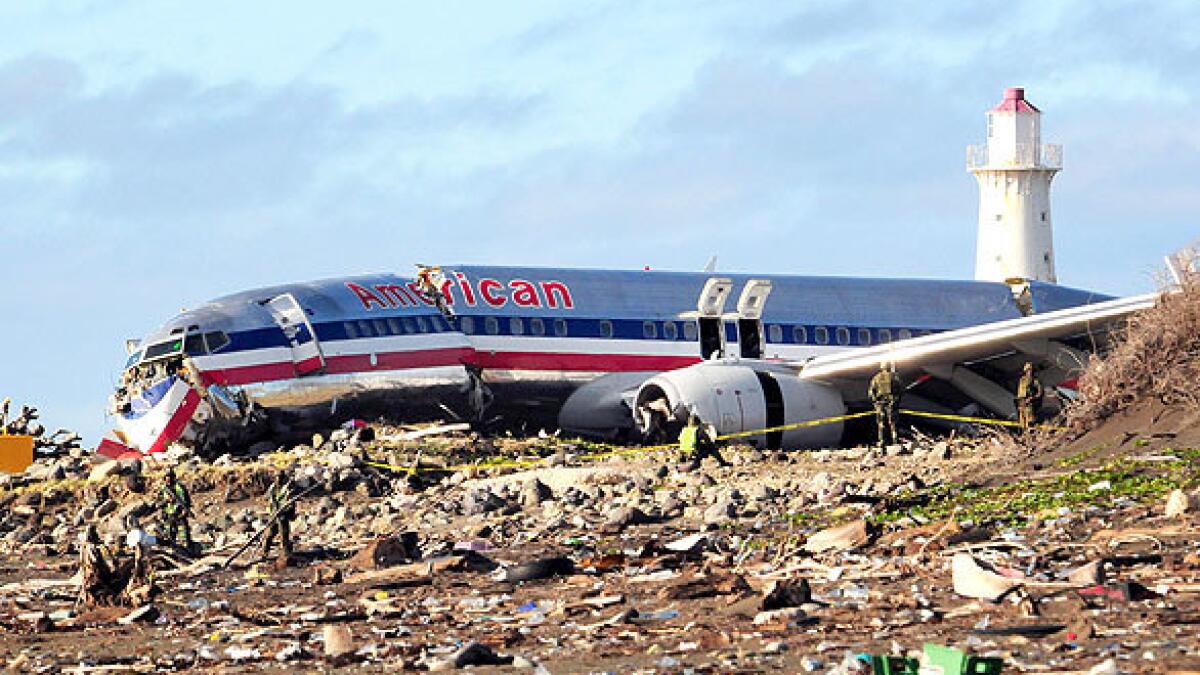
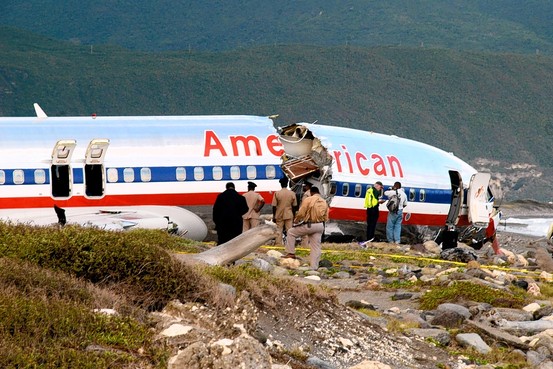
On the night of December 22, 2009, American Airlines Flight 331 was approaching Kingston, Jamaica, at the end of a routine international passenger flight from Miami, Florida. What should have been a normal arrival at Norman Manley International Airport instead became one of Jamaica’s most dramatic aviation accidents. The Boeing 737-800 landed during heavy rain, overran the runway, broke through an airport perimeter fence, crossed a roadway, and finally came to rest on a rocky beach only a short distance from the Caribbean Sea.
Remarkably, there were no fatalities. The aircraft, however, was destroyed, and numerous passengers were injured. The accident became an important case study in runway overruns, wet-runway operations, tailwind landings, crew decision-making, and the importance of recognizing when a landing should be abandoned.
According to the official investigation by the Jamaica Civil Aviation Authority, Flight AA331 was operated by American Airlines using a Boeing 737-823 registered N977AN. The aircraft was carrying 148 passengers, including three infants, and six crew members. It departed Miami International Airport at approximately 8:22 p.m. local time and was scheduled to land at Norman Manley International Airport in Kingston. (Jamaica Civil Aviation Authority)
The Flight to Kingston
The flight began normally. The Boeing 737-800 was a widely used passenger aircraft designed for short- and medium-haul routes. The aircraft had enough fuel for the scheduled flight and additional operational requirements.
As Flight 331 approached Jamaica, weather conditions around Kingston were deteriorating. Heavy rain was affecting the airport, and the runway was wet. The arrival was also taking place at night, increasing the difficulty of visually judging the runway environment and assessing the landing conditions.
The crew requested an Instrument Landing System, or ILS, approach to Runway 12. Air traffic controllers advised the crew that there was a tailwind on that runway and offered an alternative approach to Runway 30. Despite the warning, the crew continued with the approach to Runway 12. (Jamaica Information Service)
This decision would become one of the central issues examined by investigators.
A tailwind is wind blowing in the same general direction as the aircraft’s movement during landing. Even when within an aircraft’s operational limits, a tailwind can increase the aircraft’s groundspeed and lengthen the distance required to stop. When combined with heavy rain and a wet runway, the available stopping margin can become significantly smaller.
A Difficult Approach
The approach to Norman Manley International Airport was conducted in instrument meteorological conditions. The aircraft was using the ILS and the flight crew eventually became visual with the runway.
The official accident report found that the aircraft crossed the runway threshold higher than the ideal approach profile. Instead of touching down near the beginning of the runway’s designated touchdown zone, the Boeing 737 continued farther down the runway.
The runway was approximately 8,911 feet long. Flight data showed that the aircraft touched down approximately 4,100 feet beyond the threshold, leaving only about 4,811 feet of runway for the aircraft to stop. (Jamaica Civil Aviation Authority)
That was a critical development.
A landing aircraft normally needs to touch down within a designated touchdown zone so that sufficient runway remains for deceleration. Every additional foot traveled before touchdown reduces the remaining stopping distance.
The investigation concluded that the aircraft crossed the threshold about 20 feet above the ideal height and subsequently landed long. The report also found that the aircraft touched down at approximately Vref plus five knots, while a 14-knot tailwind component was present. (Flight Safety Foundation)
These factors increased the stopping challenge.
The Moment of Touchdown
When the aircraft finally touched down, the runway was covered by heavy rain. The airplane initially appeared to be making a normal landing, but the available runway was rapidly disappearing.
The aircraft’s automatic braking system activated, and spoilers and reverse thrust were deployed. The pilots also applied manual braking after recognizing that the airplane was not slowing as expected.
According to information released by Jamaican authorities, the crew reported that the aircraft did not appear to decelerate normally at first. They subsequently applied maximum manual braking. Investigators later examined the aircraft’s brakes, spoilers, and thrust reversers and found no evidence of a mechanical failure that would explain the overrun. (mtm.gov.jm)
This was an important finding. The accident was not simply a case of the aircraft’s brakes failing.
Instead, investigators focused heavily on the combination of the long touchdown, wet runway, tailwind, landing technique, weather conditions, and crew decision-making.
The Runway Overrun
As the Boeing 737 accelerated toward the end of the runway, the crew was faced with an increasingly desperate situation.
The aircraft could not stop within the remaining runway distance.
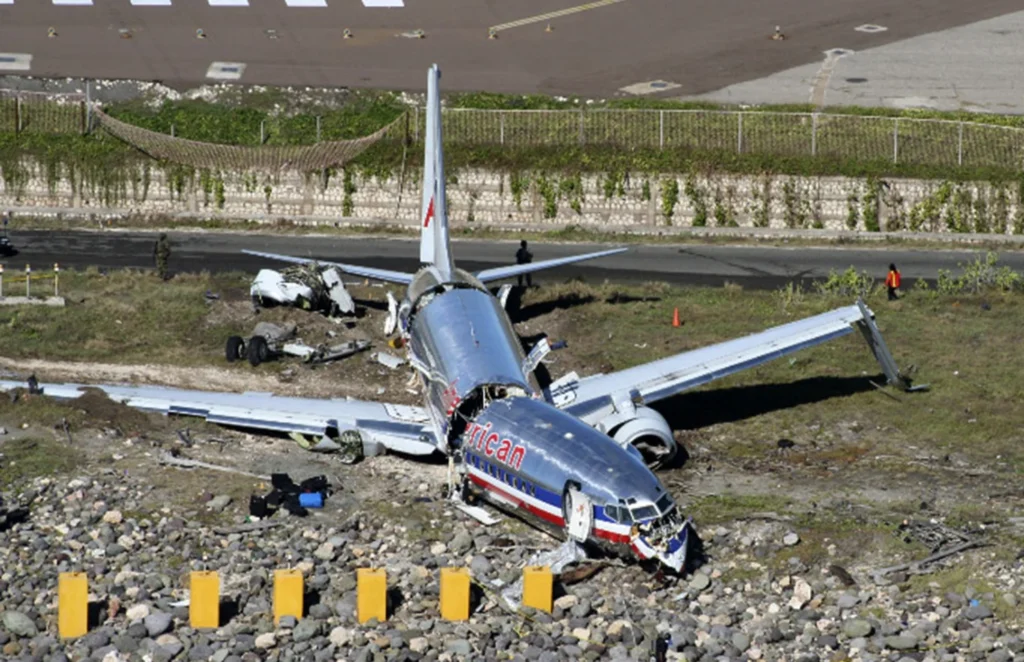
The airplane eventually departed the end of Runway 12 at approximately 62 knots groundspeed, according to the final investigation. It broke through the airport’s perimeter fence and continued beyond the airport boundary. (Jamaica Civil Aviation Authority)
The aircraft crossed above a road and then struck the uneven ground beyond the runway.
The impact with the beach area was violent.
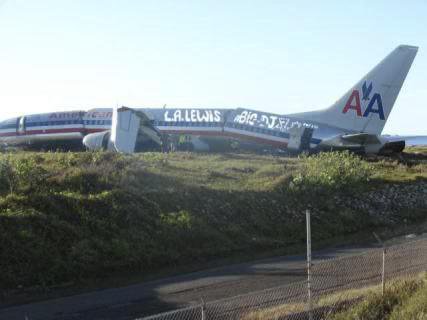
The Boeing 737 came to an abrupt stop on sand, rocks, and terrain between the roadway and the Caribbean Sea. The airplane had traveled beyond the runway and airport property, but fortunately it stopped before reaching the water.
The location of the final resting place was one of the most remarkable aspects of the accident.
The aircraft had effectively run out of usable space.

The Aircraft Breaks Apart
The force of the accident caused severe structural damage to the Boeing 737.
The fuselage broke into three major sections. The left landing gear collapsed, while the right engine and right landing gear were torn away. The left wingtip suffered severe damage, and the right wing fuel tanks were ruptured, allowing fuel to leak onto the beach.
Despite the enormous structural damage, there was no post-crash fire. (Jamaica Civil Aviation Authority)
That fact was crucial.
A large quantity of aviation fuel was present in and around the damaged aircraft. A fire could have dramatically increased the death toll.
Passengers and crew therefore faced another danger after the aircraft stopped: escaping quickly before a possible fire or fuel ignition.
Panic Inside the Cabin
The sudden impact transformed the cabin into a scene of confusion and fear.
Passengers who had expected to arrive safely in Kingston were suddenly thrown forward as the aircraft left the runway and struck the terrain.
Cabin equipment was damaged. Investigators later found that many overhead bins and passenger service units in the forward portion of the cabin had been dislodged. A significant opening developed in the fuselage between rows six and seven, and other cabin components were torn from their mounting points. (NTSB)
Passengers had to deal with darkness, damaged aircraft structures, injuries, and the possibility of fire.
Some people were trapped or injured, while others attempted to help fellow passengers.
The cabin crew played an important role in the evacuation. The official investigation noted that none of the flight crew or cabin crew suffered serious injuries and that crew members were able to assist passengers following the accident. (Jamaica Civil Aviation Authority)
Emergency Response in Kingston
Emergency crews were quickly mobilized after the crash.
The accident occurred near Kingston, and emergency responders rushed toward the wreckage. Hospitals in the area prepared to receive injured passengers.
Initial reports from Jamaican authorities indicated that dozens of people were transported to hospitals for medical treatment. Early estimates varied as officials worked to determine the exact number of injured passengers.
The Jamaica Information Service reported that emergency deployment was activated and injured passengers were transported to several hospitals in Kingston. (Jamaica Information Service)
The absence of fatalities was remarkable given the severity of the crash.
The aircraft had broken apart, an engine had separated, landing gear had failed, and the fuselage had suffered major damage. Yet everyone aboard survived.
The final investigation determined that 134 passengers suffered minor or no injuries, while 14 passengers suffered serious injuries, although none of those injuries was considered life-threatening. (Jamaica Civil Aviation Authority)

Why Did the Plane Overrun the Runway?
The investigation did not identify one simple cause.
Instead, several factors came together.
One of the most important was the aircraft’s touchdown point. The Boeing 737 landed approximately 4,100 feet from the runway threshold, leaving substantially less runway than would normally be desirable.
The aircraft also landed with a tailwind component of approximately 14 knots.
Heavy rainfall was another important factor. A wet runway can reduce tire-runway friction and make braking more difficult. Investigators found evidence consistent with reduced runway friction during the accident. (Flight Safety Foundation)
The official investigation also found that the flight crew did not sufficiently adjust its landing plan to rapidly changing weather conditions and did not select the most suitable runway for the conditions.
Another important finding was that the crew did not initiate a go-around after the aircraft’s long landing became apparent. (Flight Safety Foundation)
The Importance of a Go-Around
A go-around is one of the most important safety procedures available to pilots.
If an approach becomes unstable, the aircraft lands too far down the runway, the weather deteriorates, or the pilot determines that stopping may be difficult, the crew can add power and climb away for another attempt.
The decision can be difficult because pilots may feel pressure to complete the landing, particularly after a long flight or when they have already invested considerable time in the approach.
However, aviation safety emphasizes that a missed approach is preferable to an unsafe landing.
In the case of Flight 331, investigators concluded that the crew did not conduct a go-around when the long landing made one necessary. (Flight Safety Foundation)
This became one of the major lessons from the accident.
Was the Aircraft’s Braking System at Fault?
One of the early questions following the accident was whether the Boeing 737 had suffered a mechanical problem.
Investigators examined the aircraft’s braking system, spoilers, and thrust reversers.
The Jamaican government later reported that investigators had not found anomalies or malfunctions in those systems. (mtm.gov.jm)
This was significant because the aircraft’s inability to stop could initially appear to be evidence of brake failure.
Instead, the investigation pointed toward operational and environmental factors.
The aircraft had landed long, the runway was wet, and a substantial tailwind was present. These factors reduced the margin available to the crew.
The Role of Runway Conditions
Runway surface condition is critical during landing.
Aircraft tires depend on friction with the runway to convert speed into braking force. Rain can reduce this friction, particularly when water accumulates on the pavement.
The Flight 331 investigation found evidence of reduced friction and noted heavy rainfall around the time of the landing. (Flight Safety Foundation)
When an aircraft is traveling quickly on a wet runway, even a relatively small reduction in braking performance can have major consequences.
The aircraft’s stopping distance is also affected by weight, speed, wind, runway slope, braking configuration, and the condition of the pavement.
A tailwind adds another complication because it increases groundspeed for a given airspeed.
Therefore, the combination of a wet runway and tailwind can be considerably more challenging than either condition alone.
Human Factors
The Flight 331 accident also became an example of how aviation accidents frequently involve multiple human factors rather than one obvious mistake.
The official investigation identified issues involving situational awareness, landing technique, monitoring, decision-making, and adherence to procedures. It found that the captain did not follow company recommendations concerning landing technique, tailwind and wet-runway operations, and the landing profile. (Flight Safety Foundation)
Investigators also found that the first officer did not provide all the necessary monitoring and crew-resource-management input during the critical final stages of the flight.
Modern aviation places enormous emphasis on Crew Resource Management, commonly called CRM.
CRM encourages pilots to communicate clearly, challenge unsafe decisions when necessary, monitor aircraft performance, and work together to identify developing hazards.
The accident demonstrated why these principles matter.
The Airport Environment
Norman Manley International Airport is located on the Palisadoes peninsula near Kingston. Its location means that the airport is surrounded by water and relatively constrained terrain.
For Flight 331, the end of the runway was followed by a roadway, beach area, and the Caribbean Sea.
This geography made the overrun particularly dangerous.
Had the aircraft continued farther, it could potentially have entered the water.
Instead, the Boeing 737 came to rest on the beach before reaching the sea.
The aircraft’s final position was therefore a crucial factor in the survival of everyone aboard.
Investigation and Safety Lessons
Following the accident, investigators from Jamaica and the United States examined the aircraft, flight data recorder, cockpit voice recorder, runway, weather conditions, air traffic control communications, and crew procedures.
The Jamaica Civil Aviation Authority led the investigation, with the United States National Transportation Safety Board serving as the accredited representative. (Skybrary)
Investigators reconstructed the final minutes of the flight in considerable detail.
The evidence showed that the aircraft was not suffering from a catastrophic mechanical failure that prevented braking.
Instead, the accident resulted from a combination of factors that left the aircraft with insufficient runway to stop.
The investigation’s lessons extended beyond Flight 331 itself.
Pilots must continuously evaluate whether an approach remains safe. Weather can change quickly. A runway that appeared acceptable several minutes earlier can become unsuitable because of rain, wind, or changing braking conditions.
Landing decisions must therefore remain flexible.
A Narrow Escape
The story of Flight 331 is ultimately a story of survival.
The aircraft was destroyed, but everyone aboard survived.
The 737 had crossed almost the entire runway before touchdown and then traveled beyond the runway at significant speed. It smashed through the airport boundary, crossed a roadway, and came to rest among rocks and sand close to the Caribbean Sea.
The physical destruction was severe.
Yet the outcome could have been far worse.
There was no post-crash fire. The aircraft stopped before entering the sea. The crew survived and helped passengers evacuate. Emergency responders arrived quickly, and injured passengers were transported to hospitals.
These factors combined to prevent a potentially catastrophic loss of life.
The Legacy of American Airlines Flight 331
Flight 331 remains an important aviation safety case because it demonstrates how accidents can develop from a chain of seemingly manageable circumstances.
A tailwind by itself does not necessarily cause an accident.
Rain by itself does not necessarily cause an accident.
A slightly long landing does not necessarily result in a crash.
But when these factors occur together—and when the aircraft continues an approach after the available safety margin has deteriorated—the risks can multiply rapidly.
The accident reinforced several fundamental principles of aviation safety: land within the proper touchdown zone, respect runway and weather limitations, carefully consider tailwind conditions, monitor aircraft performance, and be willing to go around whenever the landing cannot be completed safely.
Perhaps the most powerful lesson is that pilots must be prepared to abandon a landing even when the runway is already in sight.
For the passengers of American Airlines Flight 331, the journey to Jamaica ended in a terrifying crash rather than a routine landing. But their survival also demonstrated the strength of modern aircraft, the value of emergency procedures, and the importance of rapid emergency response.
The wreckage on the beach became a dramatic visual reminder of what can happen when an aircraft runs out of runway.
More importantly, the investigation transformed the accident into a valuable safety lesson for pilots, airlines, airports, and aviation authorities around the world.
American Airlines Flight 331 did not end with the loss of 154 lives. Instead, it became a powerful example of how a combination of weather, runway conditions, aircraft performance, and human decision-making can turn an ordinary landing into an emergency—and how careful analysis of such accidents can help prevent similar events in the future.