It was supposed to be a routine training mission over the rugged mountains of Washington State. Instead, a Marine Corps fighter pilot suddenly found himself fighting for his life as his F/A-18 Hornet headed toward the forested slopes of the Cascade Mountains.
On June 13, 2026, a U.S. Marine Corps F/A-18 Hornet crashed near Rimrock Lake, approximately 55 miles southeast of Seattle. The aircraft was assigned to Marine Aircraft Group 11, part of the 3rd Marine Aircraft Wing, and was conducting a routine training flight when the accident occurred. The pilot successfully ejected and survived, suffering only minor injuries. The cause of the mishap remains under investigation. (ABC News)
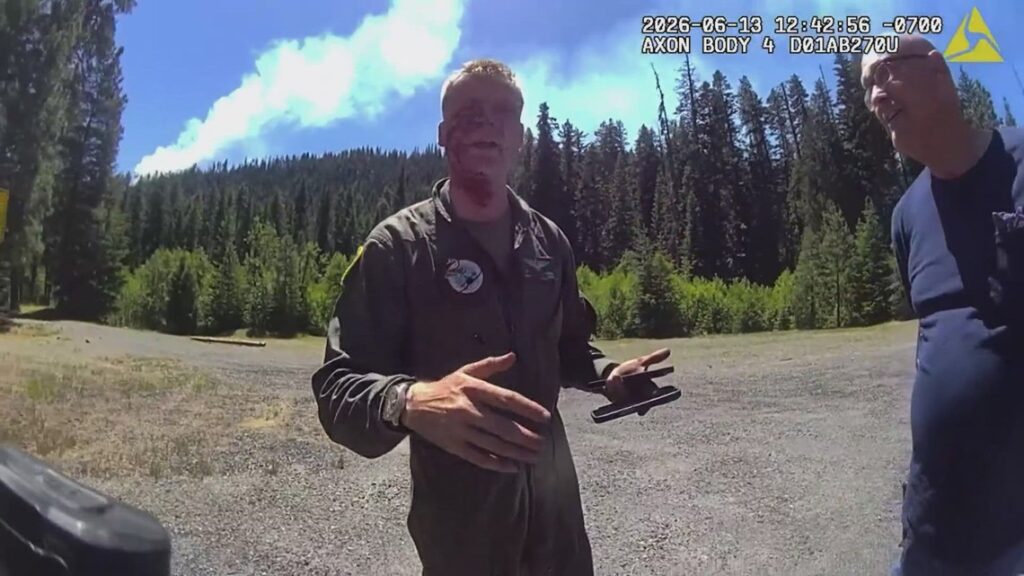
What makes the incident especially remarkable is the newly released body-camera footage showing the pilot shortly after he escaped from the doomed aircraft. The footage provides an extraordinary glimpse into what happened immediately after an experienced military aviator was forced to abandon his fighter jet in one of the most unforgiving environments imaginable.
A Routine Training Flight Turns Into an Emergency
The Cascade Mountains are beautiful from the ground, but they can be extremely challenging from the cockpit of a high-performance fighter aircraft.
The Marine F/A-18 was operating in the area around Rimrock Lake as part of a training mission. The pilot later told first responders that the aircraft had been flying circles over the lake while conducting low-level training.
Low-level military aviation requires intense concentration. At high speed and relatively low altitude, pilots have very little time to react to unexpected problems. Mountains, trees, ridgelines, weather, and changing terrain can leave almost no room for error.
According to the pilot’s own description in body-camera footage, everything changed after he “tucked in” during the training maneuver. He appeared shaken and uncertain about exactly what happened next.
The aircraft rapidly became a threat to the pilot’s survival.
Witnesses in the area captured video of the fighter jet before it disappeared toward the mountainous terrain. Moments later, the aircraft struck the mountainside, producing a huge fireball and a thick column of dark smoke. The crash also ignited a wildfire in the surrounding forest. (ABC News)
For the pilot, however, the most important event happened seconds before the impact.
He ejected.

The Decision to Eject
For any fighter pilot, ejecting from an aircraft is an emergency decision of the highest possible importance.
An ejection seat is designed to give the pilot a chance to survive when the aircraft can no longer be safely controlled. But using one is not like simply stepping out of an airplane. The pilot is violently propelled away from the aircraft, exposed to tremendous forces, and then must rely on the parachute system to bring him safely back to the ground.
In this case, the pilot had only moments to escape before the F/A-18 slammed into the mountainside.
The timing had to be precise.
Too late, and the pilot could have been carried into the trees or mountainside with the aircraft. Too early, and he could have faced a dangerous descent through rugged terrain with limited control over where he would land.
The ejection worked.
The pilot separated from the aircraft, his parachute deployed, and he came down somewhere among the trees near the crash site.
The aircraft itself continued toward the mountainside.
“That’s an F-18. Well, That Was an F-18.”
The newly released body-camera video captures the surreal moments after the ejection.
The pilot approached responding deputies while holding a phone. He appeared to have blood on his face and was visibly shaken by what had just happened.
One of the responders asked him what kind of aircraft he had been flying.
His answer was remarkably understated.
“That’s an F-18,” he explained, before correcting himself with the unforgettable observation: “Well, that was an F-18.”
The statement captures the strange reality of the situation.
Only moments earlier, the aircraft had been a sophisticated military machine carrying him through the mountains. Now it was a destroyed wreck scattered across a forested mountainside.
The pilot then explained that he and another aircraft had been conducting low-level training near the lake. He was still trying to process exactly what had happened.
“You hit the tree bad, bud,” one person told him, referring to his landing among the trees. (ABC News)
The pilot appeared confused and disoriented, but he was able to walk and communicate with the rescuers.

A Parachute Hanging in the Trees
One of the most striking details from the footage was the sight of the parachute caught in a tree.
That image tells the story better than almost anything else.
A moment earlier, the pilot had been inside a fighter aircraft traveling at high speed. Then he was separated from the jet, descending beneath a parachute toward a remote mountainous landscape.
The parachute eventually became entangled in the trees.
The pilot managed to get himself out and reach the area where responders could find him.
Although he had suffered lacerations to his face and was clearly shaken, he had survived an accident that could easily have ended very differently. Responding officers helped get him to medical care, where he was treated for minor injuries. (ABC News)
“Hey, Buddy, I Just Crashed”
Perhaps the most remarkable moment in the footage comes when the pilot makes a phone call to someone he apparently knows.
His message is almost unbelievably casual given the circumstances.
“Hey, buddy, I just crashed.”
Those words summarize the bizarre contrast of the entire incident.
For most people, a fighter-jet crash would be an unimaginable catastrophe. For a trained military pilot, however, emergency procedures are drilled repeatedly. Training prepares aviators to remain focused even when an aircraft is failing and the situation is changing by the second.
The pilot’s ability to communicate, identify the aircraft, contact emergency services, and help responders understand what had happened demonstrates how training can become instinctive during a crisis.
The Fire on the Mountainside
The destroyed F/A-18 created another emergency after the pilot had escaped.
The aircraft impacted the forested terrain and ignited a fire. Witnesses reported seeing flames and a large plume of smoke rising from the crash site.
The incident became not only an aviation emergency but also a wildfire response.
The rugged environment around Rimrock Lake made the situation particularly challenging. Search-and-rescue personnel had to deal with mountainous terrain, trees, remote roads, and the possibility of an expanding fire.
Fortunately, the pilot was able to reach responders and was not trapped at the crash site.
The accident was classified as a non-fatal aviation mishap, and no ground fatalities were reported. The Marine Corps confirmed that the cause of the crash was under investigation. (Military Times)
Why Low-Level Training Is So Demanding
Low-level fighter training is one of the most demanding forms of military aviation.
Flying at low altitude allows pilots to practice realistic tactical maneuvers and terrain-following skills. But the closer an aircraft gets to the ground, the less time the pilot has to respond to an emergency.
At cruising altitude, a pilot may have minutes to diagnose a problem.
Near a mountain, the available time can shrink to seconds.
That is why training missions involve strict procedures, communication, route planning, and constant attention to terrain.
The area around Rimrock Lake includes rugged mountain landscapes, deep valleys, steep slopes, and dense forests. The F/A-18 was flying along a low-level route through the Cascade Mountains when the accident occurred. (The Aviationist)
The environment leaves little room for mistakes.
The F/A-18 Hornet
The F/A-18 Hornet has been one of the most recognizable aircraft in U.S. naval aviation for decades.
Designed as both a fighter and attack aircraft, the Hornet was built to perform multiple missions. Its combination of speed, maneuverability, and versatility made it a central part of Marine Corps aviation for many years.
But even the most capable fighter aircraft is ultimately controlled by humans operating in an unpredictable environment.
The aircraft involved in the Washington crash was a Legacy Hornet assigned to Marine Aircraft Group 11. Reports identified it as an F/A-18D associated with Marine Fighter Attack Squadron 323, known as the “Death Rattlers.” (The Aviationist)
The aircraft was eventually destroyed in the crash.
For the pilot, however, the value of the ejection system became clear in the seconds before impact.
A Survivor’s Perspective
What makes this incident particularly powerful is that the public can now see the aftermath through the pilot’s own interaction with rescuers.
There is no dramatic Hollywood soundtrack.
There is no scripted dialogue.
Instead, there is a pilot standing on a rural road, visibly injured and confused, trying to explain to strangers that his fighter jet has just crashed.
He does not appear to be celebrating.
He appears to be processing what happened.
His face shows the physical consequences of the ejection and landing. His words reveal someone who is still trying to reconstruct the sequence of events.
“I’m a little frazzled,” he explained while describing the training flight.
That simple statement may be one of the most human moments in the entire story.
Behind the helmet, flight suit, aircraft, and military training was a person who had just experienced one of the most terrifying moments imaginable.
The Importance of Emergency Training
Military pilots train extensively for situations they hope will never happen.
They practice emergency procedures.
They practice communication.
They practice ejection procedures.
They practice survival.
They practice remaining calm when everything around them is going wrong.
The Washington crash demonstrates why that training matters.
When the aircraft became uncontrollable or otherwise unsafe, the pilot had to make a decision almost immediately. After ejecting, he had to survive the parachute descent, navigate the terrain, communicate with emergency services, and help rescuers understand where the wreckage was located.
He did all of those things.
That sequence transformed what could have been a fatal accident into a remarkable survival story.
An Investigation Still Underway
Despite the dramatic footage, many important questions remain unanswered.
What caused the aircraft to enter the dangerous situation?
Was there a mechanical problem?
Was there an issue involving the aircraft’s systems?
Did the pilot encounter an unexpected condition during the low-level maneuver?
Or was the accident caused by a combination of factors?
Those questions can only be answered through a formal investigation.
The Marine Corps has not publicly released a definitive cause, and officials have emphasized that the investigation remains ongoing. (ABC News)
That is important because early speculation following an aircraft accident can easily be wrong.
Investigators typically examine aircraft components, maintenance records, flight data, communications, weather conditions, witness statements, training procedures, and other evidence before determining what happened.
A Reminder of the Risks of Military Aviation
The survival of the pilot should not obscure the seriousness of the accident.
A modern fighter aircraft represents years of engineering, training, maintenance, and investment.
But behind every aircraft is a human being.
The Marine pilot who walked away from the crash was extremely fortunate.
His aircraft was destroyed.
The mountainside was damaged.
A fire was started.
And yet, after everything happened, the pilot was alive.
The body-camera footage makes that reality especially powerful because viewers can see the immediate aftermath rather than simply reading a short statement about an aviation accident.
There is a human face to the story.
The Moment That Could Have Ended Differently
Perhaps the most remarkable part of the entire incident is how quickly the situation changed.
One moment, the Marine pilot was conducting a training mission over the Cascade Mountains.
The next, he was ejecting from a fighter jet.
Seconds later, the aircraft was crashing into a mountainside.
Then came the parachute descent.
Then the trees.
Then the blood on his face.
Then the road.
Then the emergency call.
And finally, the arrival of rescuers.
The entire sequence unfolded in an extraordinarily short period of time.
For the pilot, those seconds likely felt much longer.
Years of training were suddenly reduced to a handful of decisions.
And one of those decisions saved his life.
A Story of Survival
The F/A-18 crash near Rimrock Lake will be remembered not simply because a military fighter aircraft was destroyed, but because its pilot survived a potentially catastrophic accident in the Cascade Mountains.
The newly released footage gives the public a rare look at what happens after a fighter pilot ejects from a damaged aircraft.
There is confusion.
There is pain.
There is fear.
But there is also training, discipline, and survival instinct.
The pilot’s calm response to the situation is perhaps the most striking element of all.
When asked what kind of aircraft he had been flying, he could only point to what had just happened.
“That’s an F-18. Well, that was an F-18.”
And later, in a remarkably simple phone call:
“Hey, buddy, I just crashed.”
Those words sound almost ordinary.
But behind them was an extraordinary story.
A fighter jet had disappeared into the Cascade Mountains.
A fire had erupted in the forest.
A parachute had come down through the trees.
And a Marine Corps pilot had somehow walked away.
For the people who witnessed the crash, it was a terrifying spectacle. For investigators, it is an accident that must be carefully understood. And for the pilot, it was a moment that will likely remain with him for the rest of his life.
The final cause of the crash remains under investigation, but one fact is already clear: the pilot survived because the emergency procedures, equipment, and training available to him worked when he needed them most. (ABC News)
In military aviation, success is not always measured by completing the mission.
Sometimes, success means making the right decision when the mission has gone completely wrong.
On that day in the Cascade Mountains, the Marine pilot made it out alive.