On May 25, 1979, American Airlines Flight 191 was preparing for what should have been a routine journey from Chicago O’Hare International Airport to Los Angeles International Airport. Instead, the flight became one of the most devastating accidents in American aviation history. The McDonnell Douglas DC-10, registration N110AA, carried 258 passengers and 13 crew members. All 271 people aboard were killed, along with two people on the ground. Two additional people on the ground were seriously injured. (NTSB)
The accident happened only moments after takeoff. The airplane appeared to be climbing normally when its No. 1 engine, mounted beneath the left wing, separated from the aircraft. The separation caused severe damage to the wing and several important systems. Although the pilots continued the takeoff, they were faced with a rapidly developing emergency that was unlike a conventional engine failure.
The tragedy ultimately became a landmark case in aviation safety because investigators discovered that the accident was not caused by a single mechanical failure. Instead, a combination of maintenance damage, aircraft design vulnerabilities, system failures, and limitations in emergency procedures created a chain of events that left the crew with almost no opportunity to recover the airplane.
A Routine Flight Begins
Flight 191 was a scheduled passenger service operated by American Airlines. Its destination was Los Angeles, and the aircraft assigned to the flight was a McDonnell Douglas DC-10-10, a wide-body, three-engine jet that had entered service during the previous decade.
On the afternoon of May 25, the weather around Chicago O’Hare was clear, with visibility reported at approximately 15 miles. There was nothing about the weather that suggested an unsafe departure. The aircraft taxied toward runway 32R, and the flight crew prepared for takeoff normally. (NTSB)
The airplane had a takeoff weight of roughly 379,000 pounds. Its three engines were operating, and the takeoff roll initially appeared completely normal.
At approximately 3:02 p.m., Flight 191 was cleared for takeoff. The captain acknowledged the clearance, and the DC-10 accelerated down the runway.
Everything changed during the final moments of the takeoff roll.
The Engine Separates
As the airplane approached rotation speed, the No. 1 engine on the left side separated from its mounting structure. The engine and pylon assembly moved upward and over the left wing before falling onto the runway.
The event was extraordinarily violent, but the pilots did not immediately know that the engine had completely separated from the aircraft.
From the cockpit, the crew experienced what appeared to be a serious engine-related emergency. The aircraft was still accelerating and was already committed to takeoff.
The engine separation also caused extensive damage beyond the loss of the engine itself. Approximately three feet of the leading edge of the left wing was damaged, and hydraulic lines were severed. The hydraulic damage caused the outboard leading-edge slats on the left wing to retract unexpectedly. (FAA)
This was critical.
The leading-edge slats are aerodynamic devices that help an aircraft generate lift at lower speeds, particularly during takeoff and landing. With the slats extended, the wing can operate safely at slower speeds. When the left-wing slats retracted while the right-wing slats remained deployed, the two wings no longer had the same aerodynamic characteristics.
The aircraft had suddenly become dangerously asymmetric.
The Pilots Continue the Takeoff
The flight crew continued the takeoff because the aircraft had already reached a critical stage of the departure.
The pilots knew that an engine-related problem had occurred, but they did not have an accurate picture of the physical damage outside the cockpit. They could not see that the entire engine and pylon assembly had disappeared from the left wing.
The DC-10 became airborne and initially climbed with its wings appearing relatively level. According to the NTSB, the aircraft climbed to approximately 325 feet above the ground before the situation became catastrophic. (NTSB)
The loss of the engine itself was not the only problem. The damage caused by the separation had disrupted the left wing’s leading-edge slat system and disabled several important indications and systems.
The aircraft’s electrical and hydraulic systems were also affected. The loss of the engine-driven generator meant that several instruments and warning systems were no longer functioning normally. Among the affected systems were the captain’s flight instruments, the left stall-warning computer, the stick-shaker warning system, and the slat-disagreement indication system. (FAA)
This meant that the pilots were dealing with an aircraft whose behavior was changing rapidly while some of the systems designed to warn them of the danger were unavailable.
The Invisible Aerodynamic Problem
The most important factor in the accident was the asymmetry between the two wings.
The right wing still had its leading-edge slats deployed. The left wing, however, had lost its outboard slats because of the hydraulic damage.
As the airplane climbed, its airspeed began to decrease. The aircraft was being flown at a speed appropriate to the emergency procedures the crew believed they were experiencing. But because the left wing had been reconfigured by the uncommanded slat retraction, its stall speed had increased.
The airplane could therefore reach a stall condition on the left wing even though the overall aircraft speed appeared to be within the expected range.
The NTSB determined that the accident resulted from an asymmetric stall followed by an uncontrollable left roll. (FAA)
This was the crucial sequence.
The left wing began losing lift while the right wing continued producing more lift. The aircraft consequently rolled sharply toward the left.
The pilots attempted to control the airplane, but the aerodynamic imbalance was too severe.
The Final Seconds
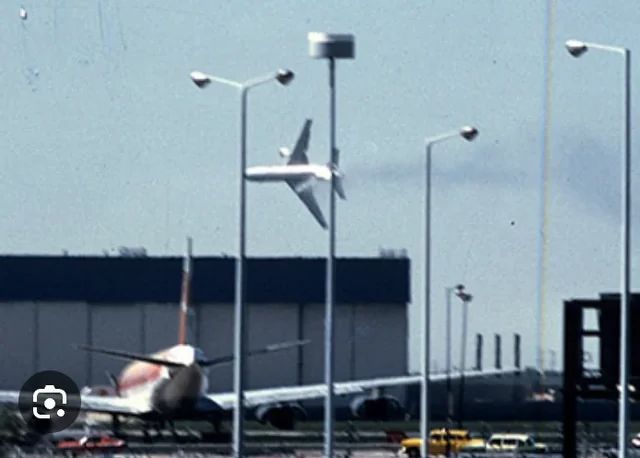
Flight 191 had been airborne for only a short time when the aircraft began its fatal roll.
The airplane initially climbed with its wings approximately level. Then the left wing dropped.
The crew attempted to counter the roll using the aircraft’s flight controls. However, the airplane continued rolling left.
The nose began to pitch downward as the bank angle increased.
Within seconds, the DC-10 passed through a steep bank angle and ultimately rolled beyond the vertical position. The NTSB investigation found that the aircraft struck the ground with approximately 112 degrees of left roll. (FAA)
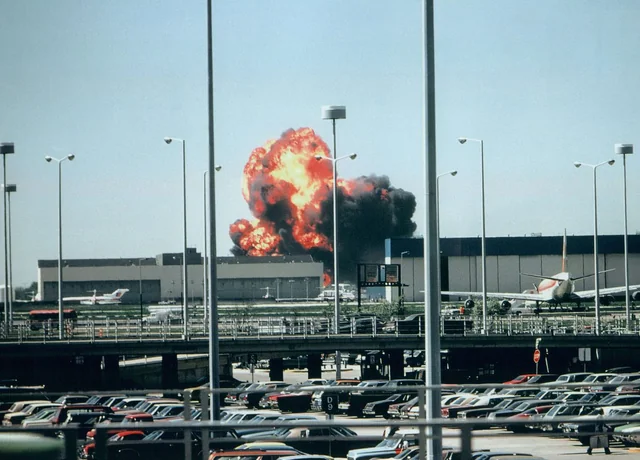
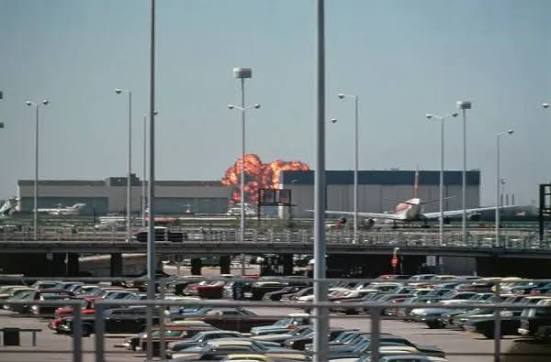
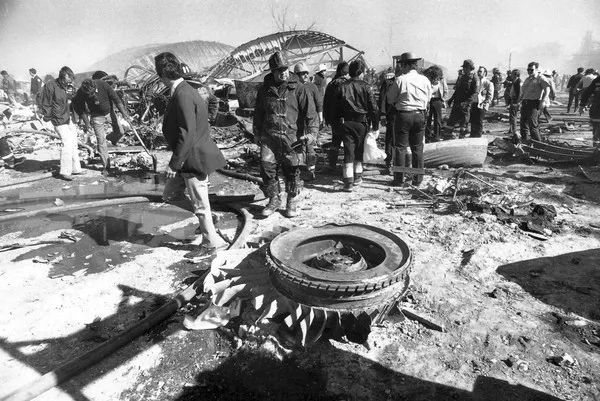
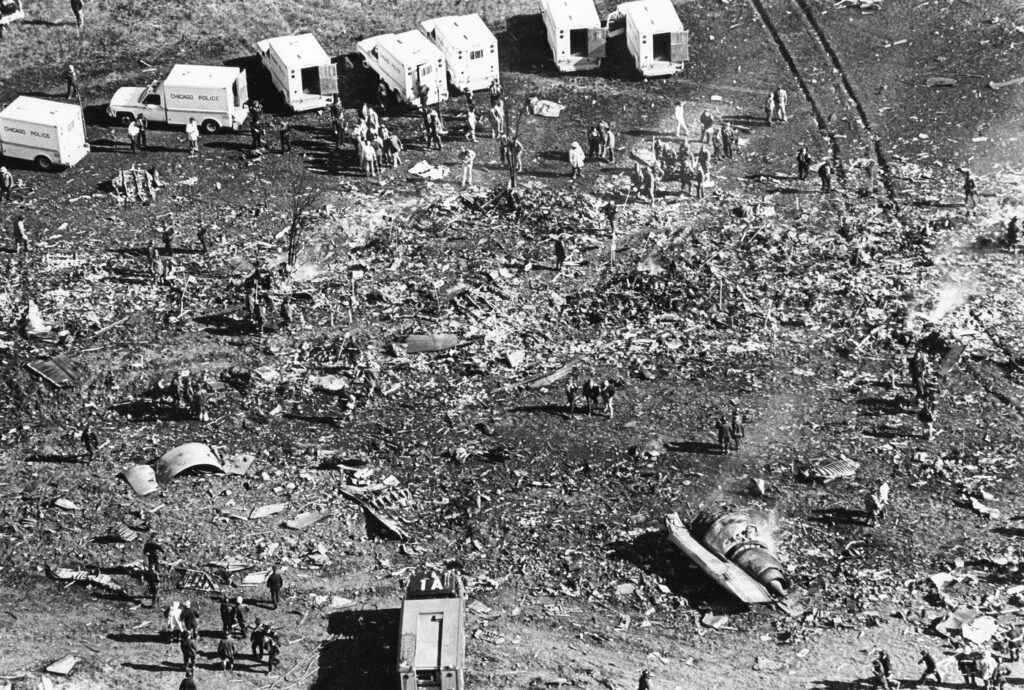
The aircraft crashed into an open field approximately 4,600 feet northwest of the departure end of runway 32R. The wreckage then spread into an adjacent trailer park area. A major post-crash fire followed. (NTSB)
The impact was catastrophic.
All 271 people aboard the aircraft died.
Two people on the ground also lost their lives, while two others suffered serious injuries. Several vehicles, a mobile home, and an old aircraft hangar were damaged or destroyed. (NTSB)

The Investigation
The crash immediately triggered a major investigation by the National Transportation Safety Board.
Investigators faced an enormous amount of wreckage and had to determine why a modern wide-body aircraft had suddenly become uncontrollable immediately after takeoff.
The discovery of the separated engine was one of the first major clues.
The No. 1 engine and its pylon had not simply failed in a normal operational sense. Investigators found evidence that the pylon structure had been damaged during maintenance.
This finding transformed the investigation.
The question became not simply, “Why did the engine fall off?” but “Why had the aircraft been placed into service with structural damage that could lead to such a catastrophic failure?”
Maintenance Procedures Become a Central Issue
The NTSB concluded that improper maintenance procedures had damaged the structure supporting the No. 1 engine.
During maintenance, the engine and pylon assembly had been removed and reinstalled. Investigators determined that the maintenance method used placed excessive loads on the pylon attachment structure.
Instead of separating the engine from the aircraft using procedures that minimized structural stress, a method involving the engine and pylon assembly together contributed to damage.
The damage was not immediately obvious.
Over time, the weakened structure became vulnerable to failure. During the Flight 191 takeoff, the loads associated with rotation became sufficient to cause the damaged pylon structure to fail.
The engine then separated from the wing at precisely the worst possible moment.
The NTSB identified the maintenance-induced structural damage as a central part of the accident chain. (NTSB)
A Chain of Failures
One of the most important lessons from Flight 191 is that the accident cannot be explained by saying simply that “the engine fell off.”
The engine separation was only the beginning.
The separation damaged hydraulic lines.
The hydraulic damage caused the left-wing slats to retract.
The unequal slat configuration created a dangerous aerodynamic imbalance.
The loss of electrical power from the engine affected warning and instrument systems.
The aircraft’s stall warning and slat-disagreement indications were compromised.
The crew therefore had limited information about the developing aerodynamic condition.
At the same time, the emergency procedures available to the pilots were not designed specifically for an engine separation that also caused a leading-edge slat reconfiguration.
The aircraft then slowed into a condition in which the left wing could stall.
The asymmetric stall caused the violent left roll.
The aircraft became uncontrollable before sufficient altitude was available for recovery.
This sequence illustrates what aviation investigators often describe as a chain of events: several individually manageable problems combine to create a disaster.

What the NTSB Determined
The NTSB’s final report identified the probable cause as the asymmetric stall and resulting roll caused by the uncommanded retraction of the left-wing outboard leading-edge slats.
That slat retraction was connected to maintenance-induced damage that led to the separation of the No. 1 engine and pylon assembly. (NTSB)
The investigation also identified several contributing factors.
Among them were vulnerabilities in the design of the pylon attachment points, vulnerabilities in the leading-edge slat system, deficiencies in Federal Aviation Administration surveillance and reporting, and weaknesses in communication between operators, the manufacturer, and regulators.
The NTSB also noted that the prescribed operational procedures were not sufficiently tolerant of this unusual emergency. (NTSB)
In other words, investigators concluded that responsibility could not be reduced to a single person or a single mechanical component.
The disaster involved maintenance practices, engineering design, regulatory oversight, information sharing, and emergency procedures.
The Impact on Aviation Safety
Flight 191 became an important case study in aviation safety.
The accident demonstrated how maintenance work can have consequences far beyond the maintenance hangar. A structural component that appears to have only minor damage can become critical when exposed to the extreme loads of flight.
It also demonstrated the importance of designing aircraft systems so that one failure does not create a dangerous chain reaction.
The accident raised questions about how engine mounting structures were inspected, how maintenance procedures were performed, and how information about previous maintenance-related damage was shared.
The NTSB specifically highlighted deficiencies in communication among the airline, aircraft manufacturer, and FAA. (NTSB)
These lessons became part of the broader evolution of aviation safety practices.
Modern aviation depends heavily on preventive maintenance, inspection procedures, engineering analysis, regulatory oversight, and detailed documentation. Every one of these layers exists partly because accidents such as Flight 191 demonstrated what can happen when multiple safety barriers fail.
Remembering the Victims
Behind the technical details were 273 human lives.
The 271 passengers and crew members aboard Flight 191 had families, friends, colleagues, and communities waiting for them.
Many passengers were traveling for ordinary reasons: vacations, business, family visits, or simply returning home. The crew members were performing what should have been a routine flight.
For the people on the ground, the disaster was equally unexpected. The aircraft came down near a populated area, turning an aviation accident into a tragedy that affected people beyond the airport and the airplane itself.
The scale of the loss was enormous.
For the families of the victims, the technical explanation of the accident could never fully express the personal consequences. Every number in the accident report represented an individual life.

The Legacy of Flight 191
American Airlines Flight 191 remains one of the most studied aviation accidents in history.
It is remembered not simply because of the number of fatalities, but because of how rapidly a routine takeoff turned into an uncontrollable emergency.
The accident demonstrated the importance of understanding aircraft systems as interconnected rather than isolated components.
An engine can be more than a source of thrust. Its attachment structure can interact with the wing. The wing can contain hydraulic lines. Those hydraulic systems can control high-lift devices. Those devices can determine stall characteristics. Electrical systems can power warning equipment. And warning equipment can provide pilots with information that may be critical during an emergency.
When several of those systems are affected at the same time, a seemingly survivable problem can become catastrophic.
Flight 191 therefore became a powerful lesson in systems safety.
A Lasting Reminder
On May 25, 1979, Flight 191 departed Chicago O’Hare for Los Angeles.
Less than a minute after becoming airborne, the aircraft had crashed.
The NTSB investigation showed that the disaster was the result of a complex chain involving maintenance-induced structural damage, engine separation, hydraulic and electrical system failures, asymmetric wing configuration, an aerodynamic stall, and the resulting loss of control. (FAA)
The accident changed the way aviation professionals thought about maintenance, aircraft design, emergency procedures, and communication between airlines, manufacturers, and regulators.
Today, Flight 191 remains a solemn reminder that aviation safety is built from thousands of individual procedures and decisions. A failure in one part of that system can create consequences far beyond what anyone expects.
The 271 passengers and crew members aboard Flight 191, along with the two people killed on the ground, are remembered as victims of one of the darkest moments in American aviation history.
Their story also became part of the continuing effort to make air travel safer.
The tragedy of Flight 191 was not caused by one simple mistake. It was a chain of failures that came together at the worst possible moment. Understanding that chain has helped aviation investigators, engineers, pilots, mechanics, airlines, and regulators recognize why every maintenance procedure, inspection, warning system, and safety rule matters.
More than four decades later, the accident continues to stand as a powerful lesson: aviation safety depends not on one protection, but on many layers of protection working together.