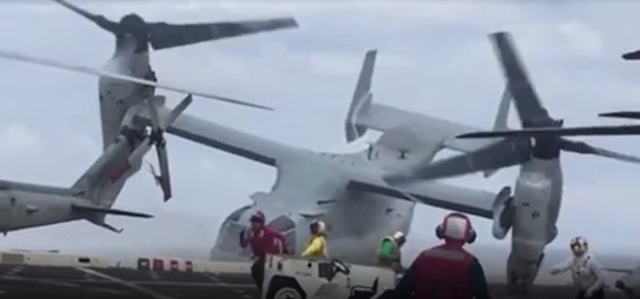
On August 5, 2017, a U.S. Marine Corps MV-22B Osprey crashed into the sea near Shoalwater Bay, Australia, during a military training exercise. The aircraft, assigned to the 31st Marine Expeditionary Unit, had been operating from the amphibious assault ship USS Bonhomme Richard and was attempting to return to the ship after conducting operations in the area. Twenty-three Marines were aboard. Twenty were rescued, but three Marines lost their lives. (Wikipedia)
The accident became one of the most painful reminders of the challenges involved in operating the Osprey, an aircraft designed to combine the vertical takeoff and landing capability of a helicopter with the speed and range of a fixed-wing airplane.
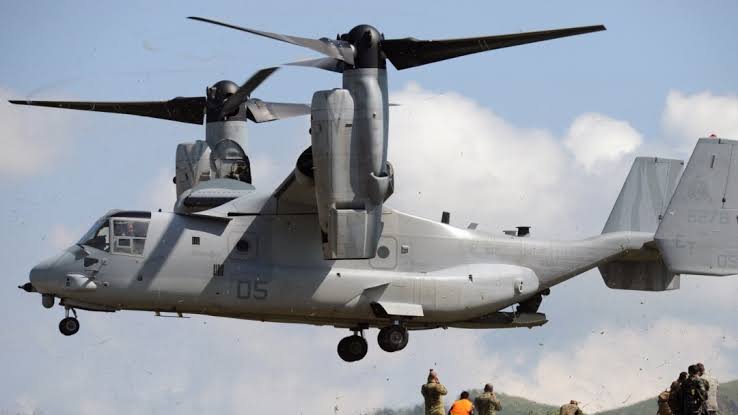
The MV-22B Osprey is a remarkable but complicated aircraft. Its two large engines and rotors are mounted on rotating nacelles at the ends of its wings. During takeoff and landing, the nacelles are positioned vertically, allowing the aircraft to operate much like a helicopter. Once airborne, the nacelles rotate forward, allowing the Osprey to fly more like an airplane.
That capability gives the aircraft tremendous advantages during military operations. Marines can be transported long distances at higher speeds than conventional helicopters while still retaining the ability to land on ships or in confined areas. But those advantages also introduce unique aerodynamic and operational challenges.
A Routine Training Mission Turns Into a Disaster
The Marines involved in the 2017 exercise were participating in a major training operation in northern Australia. The exercise brought together U.S. and Australian forces and was designed to prepare troops for complex amphibious and expeditionary missions.
The Osprey was operating as part of that larger military exercise. For the crew, the mission involved the kind of demanding flying that Marine aviators regularly train to perform: transporting personnel, operating around an amphibious assault ship, and conducting approaches to a relatively small landing area.
Shipboard aviation is particularly challenging because an aircraft is not landing on a normal runway. The pilot must account for the movement of the ship, wind conditions, turbulence, the aircraft’s weight, and the effects created by the ship itself.
An amphibious assault ship provides a substantial landing deck, but compared with a conventional airport runway, the available space is extremely limited. A pilot has very little room to recover from a problem during the final seconds of an approach.
According to later accounts of the mishap, the Osprey encountered serious difficulty as it approached the ship. The aircraft descended toward the deck but was unable to maintain sufficient lift and control. It ultimately struck the ship before falling into the water. (AP News)
For the people aboard the aircraft, the sequence unfolded extremely quickly.
The Moment Everything Went Wrong
An Osprey approaching a ship must carefully manage its power and altitude. When operating in helicopter mode, the aircraft depends heavily on its rotors to generate lift.
But the environment immediately above a ship can be complicated.
The ship’s deck changes the airflow around the aircraft. Rotor wash can interact with the deck and surrounding structures, creating turbulent and recirculating air. Instead of simply producing clean downward airflow, the aircraft can encounter disturbed air that affects its ability to generate the expected amount of lift.
This phenomenon can be particularly dangerous when an aircraft is already heavy and operating close to the limits of its performance.
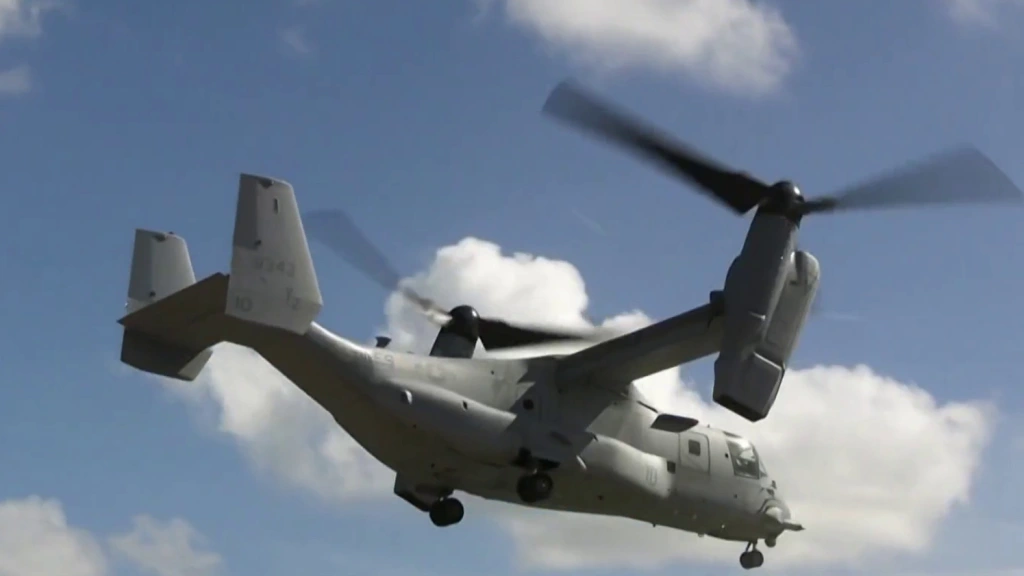
As the Osprey approached the USS Green Bay during the exercise, the aircraft began losing altitude. The pilots attempted to respond by applying additional power, but the aircraft continued downward. The Osprey eventually struck the ship and fell into the water.
The impact was devastating.
The aircraft carried 23 Marines. Twenty survived the crash and were rescued, but three Marines were killed. Their deaths sent shock waves through the Marine Corps and the wider military community. (ABC News)
The Three Marines
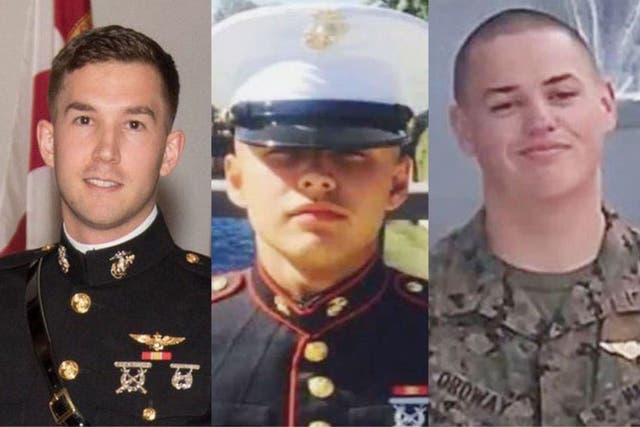
The three Marines who died were later identified as:
Corporal Spencer R. Collart, 21, of Arlington, Virginia.
Captain Eleanor V. LeBeau, 29, of Belleville, Illinois.
Major Tobin J. Lewis, 37, of Jefferson, Colorado.
They represented different stages of military service, from a young Marine corporal to experienced officers. Yet all three were performing the same basic mission: serving alongside their fellow Marines during a demanding overseas training exercise. (ABC News)
Their deaths were particularly painful because the exercise had been intended to improve readiness and strengthen cooperation between allied forces.
Training is designed to prepare military personnel for dangerous situations before those situations occur in combat. But military training itself can involve significant risks because crews must operate aircraft, ships, weapons, vehicles, and other equipment in realistic conditions.
The loss of three Marines demonstrated how quickly a training operation can become a real emergency.
The Rescue Operation
After the crash, the immediate priority was survival.
The aircraft had entered the water near the ship, creating an urgent rescue situation. Other personnel and rescue teams moved quickly to locate survivors and recover those who had been thrown into the water.
Twenty people were ultimately recovered alive.
The rescue operation involved U.S. and Australian personnel, reflecting the multinational nature of the exercise. The crash occurred in Australian waters during an exercise involving allied forces, and Australian authorities played an important role in the response and subsequent recovery effort.
For rescuers, the operation was difficult and emotionally demanding. They were not simply responding to an aircraft accident—they were searching for their fellow service members.
The recovery of the survivors brought some relief, but the discovery that three Marines had died cast a heavy shadow over the operation.
Why Landing on a Ship Is So Difficult
To understand the accident, it is important to understand the unusual demands placed on an aircraft during shipboard operations.
A conventional helicopter landing on a ship is already challenging. The pilot must compensate for wind, ship movement, waves, turbulence, and the limited size of the landing area.
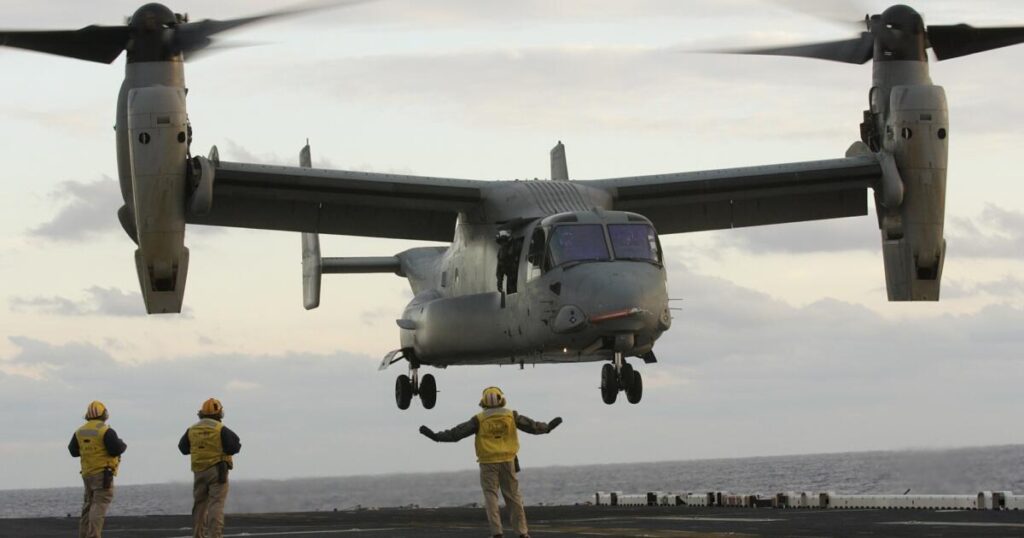
The Osprey adds another layer of complexity.
It is a tiltrotor aircraft rather than a conventional helicopter. Its engines and rotors can rotate between airplane and helicopter configurations. This allows the aircraft to fly efficiently over long distances while still being capable of vertical takeoff and landing.
However, the aircraft’s performance changes depending on its configuration, weight, speed, altitude, and environmental conditions.
During a shipboard approach, pilots must carefully control the aircraft while monitoring numerous instruments and maintaining visual references to the landing area.
A small change in altitude or power can become critical because there may be only seconds to recover.
The 2017 accident demonstrated how unforgiving this environment could be.
The Role of Weight and Environmental Conditions
Another important factor in Osprey operations is aircraft weight.
The heavier an aircraft becomes, the more power it needs to hover or climb. Marines operating from ships often carry personnel and equipment, meaning an aircraft can be operating at a significant weight during an approach.
Weather and atmospheric conditions can also influence aircraft performance.
Heat, humidity, wind, and air density all affect the amount of lift an aircraft can produce. Pilots and planners therefore calculate performance carefully before and during missions.
The Osprey was designed to operate in demanding environments, but no aircraft can escape the laws of physics.
When an aircraft is close to the limits of its performance, even a relatively small change in airflow can become significant.
The Osprey’s Difficult History
The 2017 crash occurred against a broader background of concern about the V-22’s safety record.
The Osprey program had been controversial since its earliest development. It was an ambitious attempt to create an aircraft that could perform missions normally requiring both helicopters and airplanes.
The concept was revolutionary, but developing such an aircraft was extremely difficult.
The Osprey’s history includes multiple fatal accidents during testing, training, and operational missions. A 2000 crash killed four Marines, while a 2015 accident in Hawaii killed two Marines. The 2017 Australia crash killed three more. (Wikipedia)
Later accidents would continue to raise questions about the aircraft.
In 2022, five Marines were killed in an MV-22B crash in California. A Marine Corps investigation later determined that the crash was caused by a dual hard-clutch engagement that led to a catastrophic loss of thrust from the right proprotor. The investigation characterized the mechanical failure as an unavoidable event under the circumstances. (U.S. Marine Corps)
In 2023, another Osprey crashed near Japan, killing eight service members. That accident resulted in a fleet-wide grounding and additional scrutiny of the aircraft. (Reuters)
These later events do not change the specific circumstances of the 2017 crash, but they show why the Osprey has remained the subject of intense safety analysis.
A New Generation of Military Aviation
Despite its accident history, the Osprey has provided capabilities that conventional helicopters cannot easily match.
A traditional helicopter can take off and land vertically, but its cruising speed and range are generally more limited.
A conventional airplane can travel quickly and efficiently, but it normally requires a runway.
The Osprey attempts to combine both capabilities.
Its rotors point upward for vertical flight and rotate forward for high-speed cruise. This allows Marines to travel hundreds of miles while maintaining the ability to land without a runway.
For expeditionary warfare, that capability can be extremely valuable.
An amphibious force may need to move Marines from a ship to a landing zone far inland. The Osprey can potentially accomplish that mission faster and farther than many conventional helicopters.
But with greater capability comes greater technical complexity.
The 2017 crash became part of the ongoing effort to understand the boundaries of that capability and how crews can safely operate within them.
The Human Cost
Aircraft accident investigations often focus on mechanical systems, flight profiles, weather, procedures, and pilot decisions. Those factors are essential for preventing future accidents.
But behind every investigation are people.
The three Marines who died were not simply numbers in an accident report. They were sons, daughters, friends, colleagues, and members of a military community.
Their fellow Marines had trained with them, worked beside them, and depended on them.
For their families, the accident was not an aviation statistic. It was the sudden loss of a loved one.
The Marine Corps subsequently honored the fallen and continued supporting their families and fellow service members.
The survivors also faced the emotional consequences of the accident. Surviving a catastrophic crash does not necessarily mean leaving the event behind. Service members involved in deadly accidents can carry memories of the incident for years.
Lessons From the Crash
Every military aviation accident is examined carefully because the goal is to prevent the same type of tragedy from happening again.
Investigators look at aircraft performance, crew actions, weather, maintenance, training, operational procedures, and environmental conditions.
In the case of the 2017 Osprey accident, investigators examined the aircraft’s approach to the ship and the conditions surrounding the loss of altitude and subsequent impact.
The accident highlighted the importance of understanding the Osprey’s behavior during shipboard approaches and the effects of airflow around large naval vessels.
It also demonstrated the importance of realistic training.
Military aviators must practice difficult maneuvers repeatedly because real combat operations rarely provide perfect conditions.
Training exercises expose crews to challenging environments so they can develop the skills necessary to operate under pressure.
Unfortunately, training cannot eliminate every risk.
Remembering the Fallen
Years after the crash, the names of Spencer Collart, Eleanor LeBeau, and Tobin Lewis remain connected to one of the most tragic moments in the Osprey’s operational history.
They were serving during a training exercise intended to prepare Marines for future missions.
Their deaths were a reminder that military service can be dangerous even when no combat is taking place.
The Osprey continued flying after the accident, carrying Marines around the world and supporting humanitarian, training, and combat missions.
The aircraft’s unique capabilities remain valuable, but its history has also forced military leaders, engineers, pilots, and maintainers to continuously examine how it can be operated more safely.
The story of the 2017 crash is therefore more than a story about an aircraft hitting a ship.
It is a story about the thin margin between a routine mission and catastrophe.
It is a story about the challenges of modern military aviation.
And most importantly, it is a story about three Marines who lost their lives while serving their country.
Their sacrifice became part of the history of the Marine Corps and a reminder to future generations that behind every aircraft, every mission, and every training exercise are human beings whose lives matter.
The MV-22 Osprey remains one of the most distinctive aircraft ever operated by the U.S. military. Its ability to transition from helicopter-like vertical flight to airplane-like high-speed flight transformed how Marines can move across the battlefield. But the same complexity that makes the aircraft so capable also demands rigorous training, careful planning, disciplined maintenance, and constant attention to safety.
The 2017 crash in Australia demonstrated the consequences when the demanding conditions of shipboard aviation overwhelm an aircraft’s ability to recover.
For the families and fellow Marines of Corporal Spencer R. Collart, Captain Eleanor V. LeBeau, and Major Tobin J. Lewis, the most important part of the story is not the aircraft’s technology.
It is the people who never came home.
Their memory remains a solemn reminder of the risks accepted by military personnel every time they climb aboard an aircraft and take off in service to their nation.