Douglas A-26 Invader has earned a legendary reputation as one of the most successful twin-engine attack aircraft ever built. Designed during World War II, the aircraft combined speed, durability, and firepower, allowing it to remain in military service long after the war had ended. Even decades later, the A-26 continues to captivate aviation enthusiasts at airshows and historical flight demonstrations around the world.
However, operating a vintage warbird comes with unique challenges. Despite careful maintenance and experienced pilots, aircraft that are more than 70 years old can still experience unexpected mechanical failures. One of the most dramatic incidents that can occur during a flight is a nose gear collapse on landing, an event that demands exceptional skill from the flight crew and quick action from emergency responders.

A Historic Aircraft Still Flying Today
The Douglas A-26 Invader first entered service in 1944 and quickly proved itself as one of the most versatile aircraft of its era. Unlike many wartime bombers, the Invader combined impressive speed with heavy offensive capability, making it suitable for ground attack, reconnaissance, and light bombing missions.
After World War II, the aircraft continued serving during the Korean War and later in Southeast Asia. Many surplus aircraft eventually found new lives as civilian air tankers, research aircraft, executive transports, and museum pieces. Today, only a limited number remain airworthy, making every flight a valuable reminder of aviation history.
Flying these aircraft is both an honor and a responsibility. Every takeoff represents years of restoration work, countless maintenance hours, and the dedication of volunteers, mechanics, and pilots determined to preserve history.
The Landing That Suddenly Changed
During what appeared to be a routine landing, the A-26 Invader approached the runway under normal conditions. Witnesses reported that the aircraft maintained a stable approach, with both engines operating normally and no visible signs of trouble while descending toward the runway.
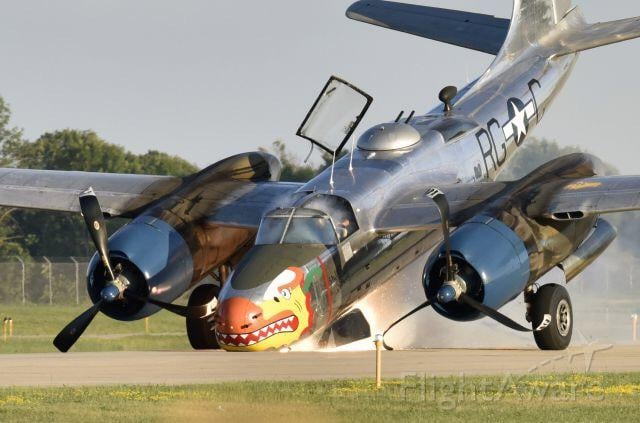
As the main landing gear touched the runway, everything initially appeared uneventful. However, moments later, the nose landing gear unexpectedly collapsed, causing the aircraft’s nose to drop sharply toward the pavement.
The sudden collapse sent sparks flying as the underside of the aircraft scraped along the runway. The propellers struck the ground almost instantly, shattering blades and creating additional debris. Despite the violent impact, the pilot maintained directional control, preventing the aircraft from veering off the runway.
The aircraft gradually slowed to a stop while emergency crews rushed toward the scene.
The Pilot’s Quick Response
Landing gear failures are among the most demanding emergencies a pilot can encounter during the landing phase. With little time to react after touchdown, maintaining aircraft control becomes the highest priority.
Rather than making abrupt steering inputs, the pilot kept the aircraft aligned with the runway centerline while allowing it to decelerate naturally. This calm response likely prevented far greater damage.
A twin-engine aircraft such as the A-26 can become unstable if one propeller experiences greater drag than the other after striking the runway. Any sudden yaw could send the aircraft sideways, potentially causing a wingtip strike or even a ground loop.

The pilot’s disciplined handling minimized these risks and ensured that the aircraft remained upright throughout the incident.
Why Nose Gear Collapses Happen
Landing gear systems experience enormous stress during every landing. Although they are engineered with significant safety margins, age and repeated use can eventually lead to mechanical problems.
Several factors can contribute to a nose gear collapse:
- Structural fatigue in aging components.
- Hydraulic system malfunction.
- Failure of locking mechanisms.
- Improper gear extension.
- Wear inside attachment fittings.
- Hard landing loads exceeding design limits.
- Corrosion hidden within internal structures.
For historic aircraft, replacement parts are often no longer manufactured. Maintenance organizations frequently rely on custom-fabricated components or carefully restored original parts. This makes inspections especially important before every flight.
Even with meticulous maintenance, some failures simply cannot be predicted.
Damage to the Aircraft
Although the collapse looked dramatic, the overall damage may have been less severe than many observers initially expected.
Typical damage from a nose gear collapse includes:
- Destroyed propeller blades.
- Bent propeller hubs.
- Engine shock loading requiring complete inspection.
- Damage to the lower fuselage.
- Scraped nose section.
- Damaged engine mounts.
- Possible firewall inspection.
- Landing gear structural repairs.
Whenever propellers strike the ground, both engines generally require extensive examination because the sudden impact can transmit powerful forces through the crankshaft and gearbox assemblies.
While repairs can be expensive, experienced restoration teams have successfully returned many vintage warbirds to flight after similar incidents.
Emergency Response
Airport firefighters and rescue personnel responded immediately after the aircraft came to rest.
Their first priorities included:
- Confirming the pilot safely exited the aircraft.
- Checking for fuel leaks.
- Preventing potential fire hazards.
- Securing electrical systems.
- Monitoring the engines.
- Protecting the aircraft from further damage.
Fortunately, nose gear collapses do not always result in fire. Quick emergency response greatly reduces the risk, particularly when leaking fuel or damaged engine components are involved.
Witnesses praised the professionalism of both the pilot and emergency crews throughout the incident.
The Challenges of Flying Vintage Aircraft
Unlike modern airplanes equipped with advanced onboard diagnostics and digital monitoring systems, aircraft like the A-26 rely heavily on traditional mechanical systems.
Many parts were designed during the early 1940s using manufacturing methods and materials available at the time. Although restoration specialists continually inspect and overhaul these aircraft, age itself remains a constant challenge.
Operating vintage warbirds requires:
- Extensive maintenance programs.
- Specialized mechanics.
- Regular structural inspections.
- Custom replacement parts.
- Careful flight planning.
- Conservative operating procedures.
Owners often invest hundreds of thousands—or even millions—of dollars restoring these historic aircraft to flying condition.
Lessons Learned
Every aviation incident becomes an opportunity to improve safety.
Investigators will likely examine:
- Landing gear components.
- Hydraulic systems.
- Maintenance records.
- Previous inspections.
- Pilot actions.
- Aircraft weight and balance.
- Runway conditions.
- Weather during landing.
The findings help operators of similar aircraft identify potential issues before another failure occurs.
For vintage aircraft operators worldwide, lessons learned from one incident can improve the safety of an entire fleet.
Preserving Aviation History
Although seeing a historic aircraft damaged is disappointing, incidents like this also demonstrate the remarkable resilience of both the aircraft and the people who preserve them.
Many surviving A-26 Invaders have already endured decades of military service, long-term storage, restoration projects, and thousands of maintenance hours before returning to flight. Their continued operation depends on passionate pilots, engineers, mechanics, volunteers, and aviation museums dedicated to preserving aviation heritage.
Even after a nose gear collapse, restoration remains possible. Numerous historic aircraft have returned to the skies following extensive repairs, allowing future generations to witness these rare machines in flight rather than only in museums.
Conclusion
The A-26 Invader nose gear collapse on landing serves as a powerful reminder that aviation—even with the most experienced crews and best maintenance practices—always carries inherent risks. Mechanical failures can occur without warning, particularly in aircraft that have served for more than seven decades.
Thanks to the pilot’s professionalism, calm decision-making, and effective emergency response, the incident concluded without a catastrophic outcome. While the aircraft sustained significant damage, the preservation of human life remains the greatest success.
As investigators determine the exact cause of the landing gear failure, the aviation community will undoubtedly study the event carefully. Every lesson learned contributes to safer operations for vintage aircraft everywhere, ensuring that legendary warbirds like the Douglas A-26 Invader can continue inspiring aviation enthusiasts for years to come.