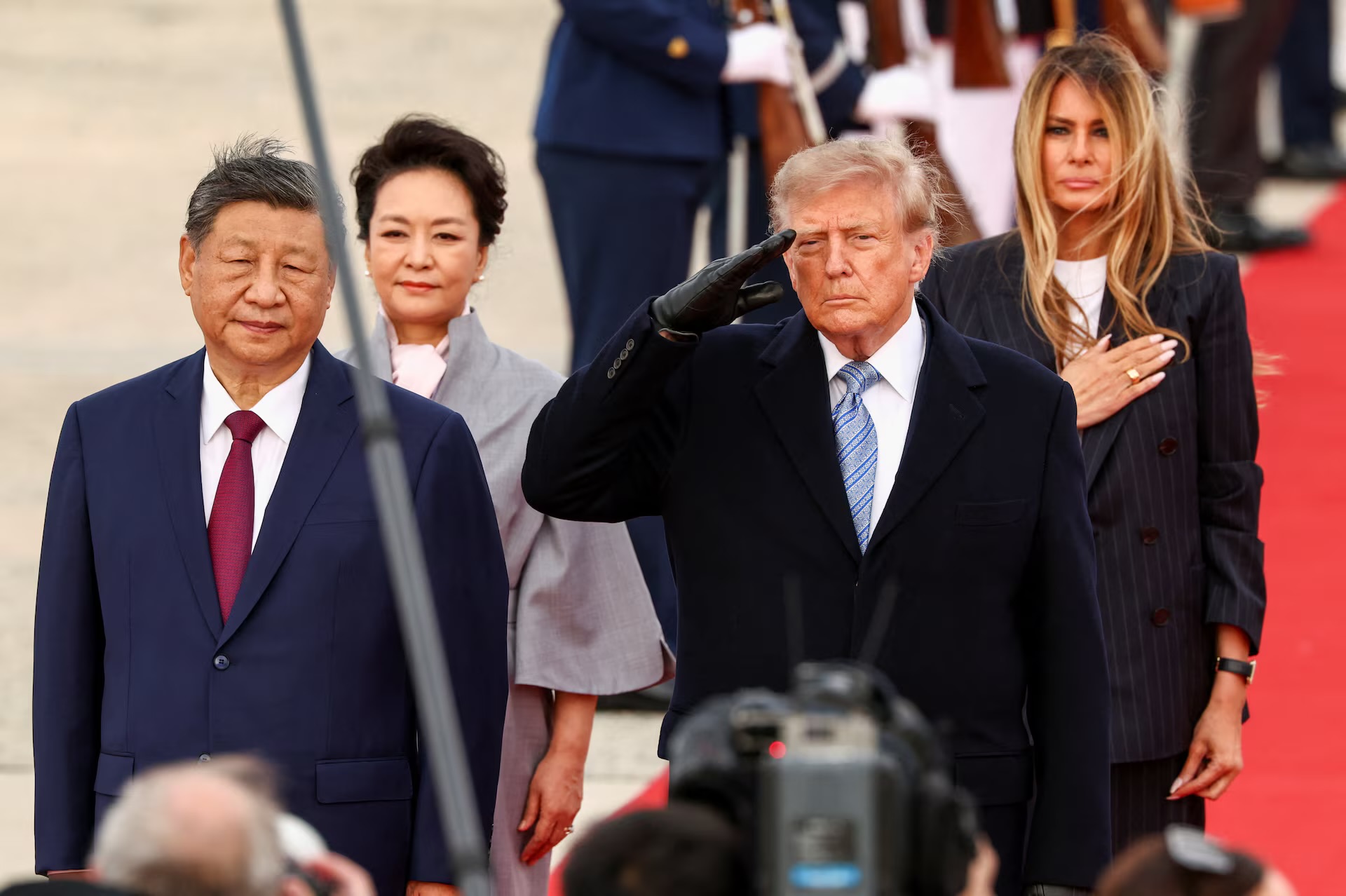
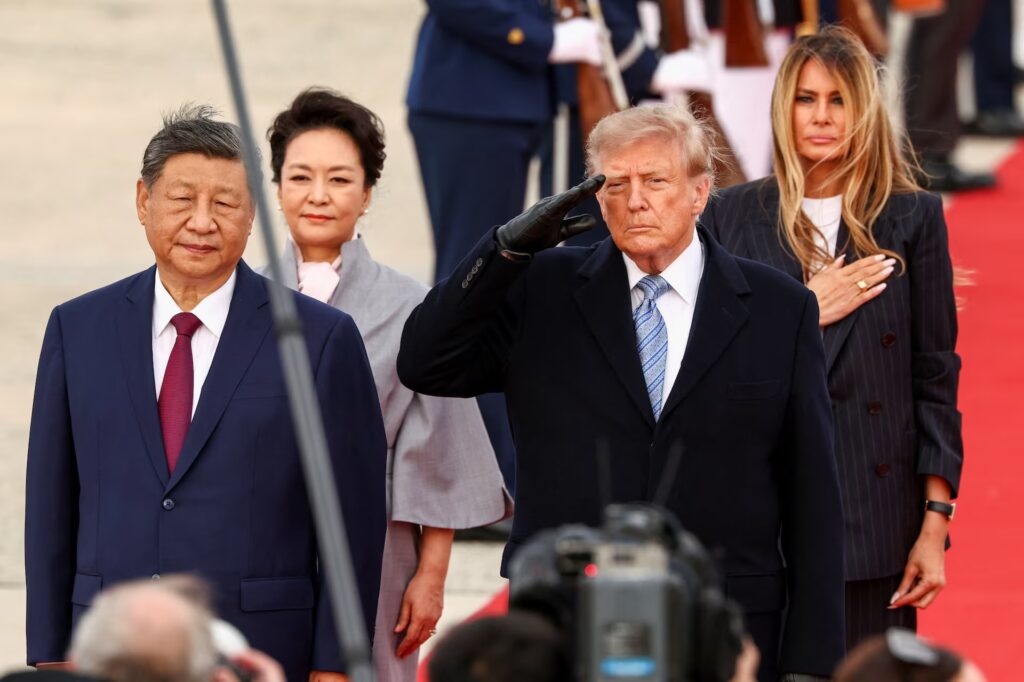
Chinese President Xi Jinping arrived in the United States on September 23, 2026, for a high-profile state visit hosted by President Donald Trump. His arrival at Joint Base Andrews, Maryland, was marked by an elaborate ceremony featuring military honors, national anthems, a 21-gun salute and a dramatic flyover by two U.S. Air Force B-1B Lancer bombers. (DVIDS)
The B-1B flyover immediately attracted international attention because of the aircraft’s distinctive role in the U.S. military. The two bombers were assigned to the 7th Bomb Wing at Dyess Air Force Base, Texas, and flew over Joint Base Andrews during the arrival ceremony for Xi and his wife, Peng Liyuan. The U.S. Air Force officially documented the flyover as part of the president’s state visit. (DVIDS)
A Powerful Military Display
The B-1B Lancer is a long-range, supersonic bomber designed to carry conventional weapons and conduct long-distance strike missions. Its presence during the ceremony provided a highly visible representation of American military capability.
The flyover was only one element of the military display. Reports from the ceremony also described formations involving F-16 and F-22 fighter aircraft, along with a 21-gun salute and military personnel positioned along the red carpet. (South China Morning Post)
The combination of diplomatic ceremony and military aviation created striking images as Trump and Xi stood together on the tarmac.
However, there is an important distinction between what happened and how it is interpreted. The U.S. government has documented the B-1B flyover as part of the official arrival ceremony, but there is no public official statement establishing that Trump ordered the bombers specifically to intimidate or threaten Xi Jinping. The flyover can therefore be understood as part of the ceremonial military honors accompanying the state visit. (DVIDS)
Trump Personally Welcomes Xi
Another notable feature of Xi’s arrival was Trump’s decision to personally greet the Chinese president at Joint Base Andrews.
Such a planeside welcome is unusual for a visiting foreign leader and underscored the importance Washington placed on the visit. Trump and First Lady Melania Trump welcomed Xi and Peng before the official ceremony began. (The Washington Post)
The visit comes at a sensitive moment in U.S.-China relations. Washington and Beijing continue to negotiate over trade, technology, artificial intelligence, rare-earth materials and broader strategic issues.
The two governments have also been working to manage economic tensions. Reports indicated that the existing trade truce was extended as the leaders prepared for their discussions. (Daily Sabah)
The B-1’s Message
The appearance of the B-1B Lancers created an unmistakable visual message about the scale of American military power. Unlike a normal diplomatic meeting, Xi’s arrival was accompanied by some of the most recognizable aircraft in the U.S. military inventory.
For observers around the world, the scene raised questions about the balance between diplomacy and military signaling.
The B-1B is particularly notable because of its speed, range and large weapons capacity. Although it was originally developed with a nuclear mission in mind, the aircraft is now configured for conventional operations.
Its flyover therefore carried significant symbolic weight, even though its presence was part of a formal ceremony rather than an announced military operation.
Xi Remains Calm During the Flyover
The loud roar of the bombers also became one of the most widely discussed moments of the ceremony.
Video and photographs showed Trump reacting to the noise as the B-1 aircraft passed overhead, while Xi watched the aircraft. Reuters images captured Trump’s reaction during the flyover, while other reports noted the contrast between the two leaders’ visible reactions. (Reuters Connect)
The moment quickly attracted attention online because of the dramatic sound and appearance of the aircraft.
But beyond the viral images, the larger significance was diplomatic. The two leaders were meeting during a period in which Washington and Beijing are attempting to manage disagreements without allowing tensions to escalate further.
Trade, Technology and Strategic Stability
The state visit is expected to cover a wide range of issues.
Trade remains one of the central subjects. Both countries have significant economic interests at stake, including tariffs, agricultural purchases and access to critical minerals.
Artificial intelligence is another major issue. The United States and China are competing for technological leadership while also discussing the risks associated with advanced AI systems.
Taiwan is another sensitive issue in the broader U.S.-China relationship. Beijing has repeatedly opposed U.S. arms sales to Taiwan, while Washington maintains its longstanding policy regarding Taiwan’s self-defense. Reuters reported ahead of the visit that Xi was expected to raise the issue during discussions with Trump. (Reuters)
A Symbolic Start to a High-Stakes Meeting
The B-1B flyover provided one of the most dramatic images of Xi Jinping’s arrival in Washington.
Two American bombers passing overhead while the presidents of the world’s two largest economic powers stood together created a powerful visual contrast: diplomacy on the ground and military power in the sky.
Whether the flyover should be interpreted primarily as ceremonial tradition, a display of American military capability, or broader diplomatic symbolism is open to interpretation. What is documented is that the B-1B Lancers from Dyess Air Force Base participated in the official arrival ceremony at Joint Base Andrews. (DVIDS)
Xi’s visit is scheduled to run from September 23 to September 25, 2026. The meetings between Trump and Xi are expected to focus on managing disagreements while exploring areas where the two countries can continue cooperation. (Reuters)
For now, the image of Trump and Xi standing beneath the roar of B-1 bombers has become one of the defining scenes of the Chinese president’s 2026 state visit to the United States.
The aircraft may have been part of a ceremonial flyover, but the moment highlighted the extraordinary combination of diplomacy, economic competition and military power that defines the modern U.S.-China relationship.