U.S. Navy CH-46D Sea Knight Helicopter Landing Accident on the USNS Pecos (December 1999)
In December 1999, a dramatic aviation accident involving a U.S. Navy CH-46D Sea Knight helicopter occurred during landing operations aboard the fleet replenishment oiler USNS Pecos (T-AO-197). Although the incident did not become one of the most widely known naval aviation accidents, it remains a powerful example of the risks military helicopter crews face while conducting routine operations at sea. The event highlighted the importance of pilot training, crew coordination, shipboard procedures, and the remarkable survivability of the rugged CH-46 Sea Knight.
The Boeing Vertol CH-46 Sea Knight, affectionately nicknamed the “Phrog” by its crews due to its distinctive appearance, served as one of the U.S. Navy and Marine Corps’ primary medium-lift transport helicopters for decades. Powered by two turboshaft engines and equipped with tandem rotors, the CH-46D was designed to transport personnel, cargo, medical casualties, and supplies between ships and shore. It was especially valuable during underway replenishment operations, where helicopters transferred critical cargo between vessels while both ships remained underway.
The USNS Pecos, operated by the Military Sealift Command, played a crucial logistical role by supplying fuel, food, ammunition, and equipment to U.S. Navy warships deployed around the world. Helicopter operations were an essential part of its mission, requiring pilots to land safely on relatively small flight decks that constantly moved with the ocean’s waves.
During the December 1999 incident, the CH-46D approached the flight deck of the USNS Pecos under normal landing procedures. However, as the helicopter descended toward the deck, something went wrong in the final moments of the approach. Whether influenced by challenging sea conditions, deck movement, wind effects, or pilot workload, the aircraft experienced an unstable landing.
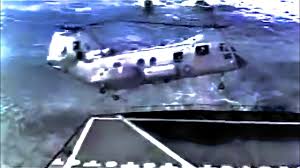
The helicopter touched down hard, causing the landing gear to absorb forces beyond its intended limits. The aircraft then rolled onto its side, with its spinning rotor blades striking the flight deck. The powerful impact shattered rotor blades into multiple fragments, sending debris across the landing area. Within seconds, the helicopter came to rest on its side, leaving the aircraft heavily damaged.
Photographs taken after the accident reveal the dramatic aftermath. The fuselage remained largely intact, but the tandem rotor system had suffered catastrophic destruction. Broken rotor blades lay scattered across the deck while maintenance crews and emergency response personnel quickly secured the crash site. Despite the violent nature of the accident, the strong structural design of the CH-46 helped protect those inside.
One of the most remarkable aspects of the incident was the survival of the crew. Military helicopter crews undergo extensive emergency training for situations exactly like this. They are taught to react immediately after an accident by shutting down aircraft systems, evacuating safely, and coordinating with shipboard firefighting and rescue teams. The professionalism and rapid response of both the aircrew and the sailors aboard the USNS Pecos helped prevent the situation from becoming even more serious.
Operating helicopters aboard ships is one of the most demanding environments in aviation. Unlike land-based airports, flight decks at sea are constantly moving due to waves, wind, and ship motion. Pilots must carefully judge altitude, closure rate, and deck movement while maintaining precise control of the aircraft. Even experienced aviators can encounter unexpected conditions during the final seconds of landing, where there is little margin for error.
The CH-46 Sea Knight itself earned a reputation as a durable and dependable aircraft throughout its long service life. Introduced during the 1960s, it participated in the Vietnam War, humanitarian relief operations, combat deployments, disaster response missions, and countless logistical flights across the globe. For more than four decades, the aircraft transported millions of pounds of cargo and hundreds of thousands of service members.
Accidents such as the December 1999 landing mishap are thoroughly investigated by the U.S. military. Investigators analyze flight data, maintenance records, weather conditions, pilot actions, mechanical systems, and ship operations to determine contributing factors. The objective is not to assign blame but to improve safety, update procedures, enhance training, and prevent similar incidents in the future.

Naval aviation has consistently evolved through lessons learned from accidents and near misses. Improvements in pilot instruction, flight deck procedures, aircraft maintenance, navigation systems, and operational planning have significantly increased safety over the years. Every investigation contributes valuable knowledge that benefits future generations of military aviators.
The CH-46D Sea Knight continued serving for several years after the accident before gradually being replaced by newer aircraft such as the MV-22B Osprey. While the Osprey introduced tiltrotor technology and greater speed, range, and payload capacity, many aviators still remember the CH-46 with great respect for its reliability and long history of service.
The December 1999 landing accident aboard the USNS Pecos serves as a reminder that even routine military operations involve significant risks. It also demonstrates the resilience of both the aircraft and the highly trained personnel who operate them. Thanks to effective emergency response, disciplined crew actions, and the robust engineering of the CH-46 Sea Knight, what could have become a far more tragic event instead became an important lesson in naval aviation safety. Today, the incident remains a testament to the professionalism, courage, and dedication of U.S. Navy and Military Sealift Command personnel who safely conduct complex flight operations in one of the world’s most challenging environments.