The JS Soryu (SS-501), one of Japan’s Soryu-class diesel-electric submarines, became the center of international attention after a serious collision with a commercial bulk carrier off the coast of Japan on February 8, 2021. The accident occurred during a routine training mission near Cape Ashizuri in Kochi Prefecture, southern Japan. The submarine was in the process of surfacing when it collided with the Hong Kong-registered bulk carrier Ocean Artemis. Three members of the submarine’s crew suffered minor injuries, while the submarine sustained significant damage to its upper structures, including its sail, antenna masts, and starboard diving plane. (ISPSW)
The incident was particularly striking because photographs taken after the collision revealed damage that was considerably more extensive than initial reports suggested. The submarine’s main pressure hull was not reported to have suffered catastrophic structural damage, allowing the Soryu to remain afloat and eventually travel under its own power to Kochi. However, the damage to the sail and diving equipment demonstrated just how violent the encounter had been.
A Powerful Submarine in a Dangerous Environment
The Soryu class represents an important generation of Japanese conventional submarines. According to Japan’s Ministry of Defense, the class is approximately 84 meters long, 9.1 meters wide, and has a standard displacement of about 2,950 tons. It was designed for stealth, endurance, and underwater operations, making it one of the most capable conventional submarine classes operated by Japan. The class has a crew of approximately 65 personnel and uses diesel engines, Stirling engines, and an electric propulsion system. (Japan Ministry of Defense)
JS Soryu was the first submarine of the class and was commissioned in 2009. Like other submarines, it is designed to operate beneath the surface, where avoiding detection is a major part of its mission. That makes situations involving nearby surface vessels particularly challenging.

When a submarine is operating at shallow depth or transitioning toward the surface, the crew must carefully monitor surrounding traffic. A large commercial ship can be difficult to detect and track in time because of the complex underwater acoustic environment. At the same time, the commercial vessel may have limited awareness that a submarine is operating beneath or near its path.
This combination of factors can create an extremely dangerous situation.
The Collision With Ocean Artemis
On the morning of February 8, 2021, the Soryu was conducting a training operation in waters approximately 40 kilometers southeast of Cape Ashizuri. Reports placed the collision at around 10:58 a.m. local time. The submarine was surfacing when it came into contact with Ocean Artemis. (ISPSW)
The collision caused damage concentrated around the upper portion of the submarine. Initial reports described damage to the communications equipment, periscope, antenna mast, and conning tower. Later photographs provided a much clearer picture.
The sail, sometimes called the submarine’s conning tower, sits above the main hull and contains or supports equipment that submariners need when operating near the surface. Depending on the submarine’s design, this area can carry masts, antennas, periscopes, sensors, and other equipment.
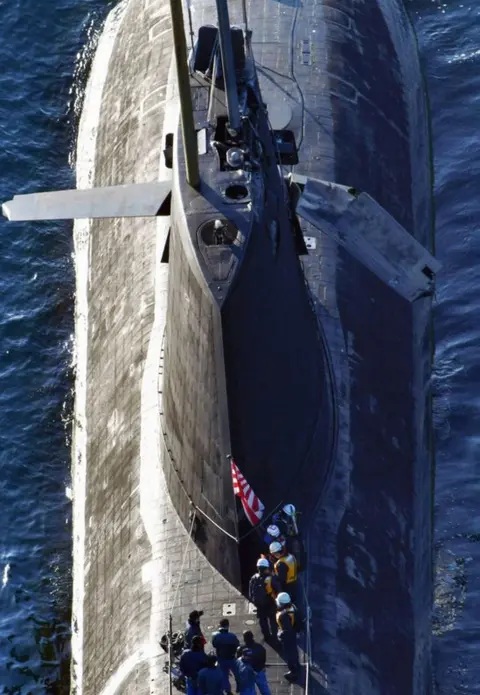
Photographs of the Soryu after the accident showed that the upper structure had been badly damaged. Several components appeared bent or broken, while parts of the outer covering were missing.
The starboard diving plane was also severely damaged. Reports described it as being almost broken in two. This was significant because diving planes are essential to controlling a submarine’s depth and attitude underwater. (TWZ)

Why Damage to the Sail Matters
The sail is not the same thing as the submarine’s main pressure hull. The pressure hull is the critical structure designed to withstand the enormous pressure encountered at depth. The sail is an external structure mounted above it.
This distinction is important because photographs showing a badly damaged sail can make a submarine appear more severely destroyed than it actually is structurally.
Nevertheless, damage to the sail can have serious operational consequences. Modern submarines rely on numerous systems located in or around this structure. Antennas and masts are necessary for communications, navigation, surveillance, and other functions. A collision that bends or destroys these systems can significantly reduce a submarine’s ability to communicate with commanders and operate safely.
In the Soryu incident, the damage to the mast array reportedly affected normal communications. The submarine was unable to immediately report the accident through its usual communications channels and eventually had to reach an area where alternative communications were possible. (Defense News)
This illustrates an important characteristic of submarine operations: a submarine can remain physically capable of moving while simultaneously losing important mission systems.

The Starboard Diving Plane
One of the most dramatic parts of the damage was the starboard hydroplane, or diving plane.
Diving planes work somewhat like underwater control surfaces. By changing their angle, a submarine can control its movement up and down while maintaining stability. Damage to one of these surfaces can make underwater maneuvering much more difficult.
Photographs showed the starboard diving plane hanging at an abnormal angle and appearing severely fractured. Some reports described it as almost broken off. (TWZ)
For a submarine, this is a major concern. Even if the pressure hull remains intact, damage to a diving plane can affect the boat’s ability to control depth. A submarine with compromised control surfaces may therefore be forced to remain on the surface or operate under strict restrictions until repairs are completed.
The fact that Soryu was able to return to port under its own power demonstrated that its propulsion and basic navigational capabilities remained functional.
Injuries to the Crew
Three Soryu crew members were injured during the collision. Their injuries were reported as minor, and none required emergency evacuation. (Default)
Even a relatively minor collision can be dangerous inside a submarine. The interior is filled with machinery, pipes, cables, equipment, and narrow passageways. A sudden impact can throw crew members against structures or equipment.
The survival of the crew without serious injury was therefore an important aspect of the incident.
The accident also demonstrated the importance of training and emergency procedures. Submarine crews routinely practice responses to unexpected situations because they may have only seconds to react when operating underwater.
Why the Main Hull Was So Important
Perhaps the most reassuring aspect of the accident was that the submarine’s main pressure hull was not reported to have suffered catastrophic structural damage.
A submarine’s pressure hull is fundamentally different from its external structures. It must resist enormous water pressure while the vessel is submerged. Serious penetration or deformation of the pressure hull could potentially create a life-threatening emergency.
In the Soryu case, the available reporting indicated that the submarine remained capable of sailing to port under its own power. A fact-checking report also noted that there was no reported structural damage to the main hull. (HKBU Fact Check)
This meant that, although the submarine required significant repairs, the accident did not become a catastrophic submarine-loss scenario.
Communication Problems After the Collision
One of the most interesting aspects of the incident was the effect on communications.
A submarine normally depends on sophisticated communication systems to remain connected with naval command structures. Damage to antennas and masts can immediately create operational difficulties.
Reports indicated that the Soryu’s antenna mast array was damaged, affecting its ability to communicate normally. The submarine continued moving and eventually reached an area where it could use alternative communications before making its way to Kochi. (Defense News)
This situation highlights how interconnected modern naval systems are. A submarine may have an intact engine and pressure hull, but damage to relatively small external components can dramatically reduce its ability to communicate and conduct its mission.
The Commercial Ship
The other vessel involved was Ocean Artemis, a large commercial bulk carrier. Early reports indicated that the ship did not initially appear to have suffered major damage or injuries. Later inspection information reported evidence of contact on the ship’s bow, including marks and damage associated with the collision. (Daisetsuzan)
The difference between the visible damage to the two vessels is understandable when considering their size and construction.
A large bulk carrier has enormous mass and structural strength. A submarine, although extremely robust, is designed primarily around maintaining pressure resistance and underwater performance rather than absorbing collisions with large surface ships.
The collision therefore created a dangerous mismatch between two very different types of vessels.
Questions About What Happened
Following the accident, investigators examined how the two vessels came into contact and why the collision occurred.

Because the submarine was surfacing during a training mission, the exact circumstances surrounding its approach to the surface were particularly important. Investigators needed to understand what information was available to the crew, how surface traffic was detected, and how the submarine and commercial ship were moving relative to each other.
It is important not to assume a definitive cause without relying on the findings of official investigations. Early speculation circulated widely online, but reports emphasized that the investigation was necessary to establish the circumstances of the collision. (HKBU Fact Check)
This is especially important in maritime accidents, where small differences in timing, visibility, speed, depth, and maneuvering can completely change the outcome.
Lessons for Submarine Operations
The Soryu collision provides several important lessons about submarine operations.
First, operating near the surface can be extremely dangerous. Submarines are most difficult to detect when submerged, but the transition toward the surface introduces new risks involving commercial traffic.
Second, communication systems are essential. Damage to antennas and masts can quickly isolate a submarine from its normal command network.
Third, external equipment can be vulnerable even when the pressure hull remains intact. Diving planes, masts, sensors, and other structures can suffer major damage from a collision.
Finally, the accident demonstrates the importance of disciplined watchkeeping and coordination between naval and civilian maritime traffic.
A Dramatic Image of Damage, But Not a Lost Submarine
Images of JS Soryu after the collision showed a submarine with a heavily damaged sail, broken equipment, and a badly damaged starboard diving plane. To a casual observer, the submarine might have appeared close to being destroyed.
But the reality was more complicated.
The main pressure hull remained sufficiently intact for the submarine to reach port under its own power. The crew survived, with only three minor injuries reported. The damage was serious enough to require repairs and investigation, but it did not result in the loss of the submarine. (Default)
The incident remains a powerful reminder of the risks involved when submarines operate around large commercial vessels. Beneath the surface, visibility is limited, sound behaves differently, and a few seconds can determine whether two vessels pass safely or collide.
For JS Soryu, the February 2021 collision became one of the most notable incidents in the operational history of the Soryu-class submarines. The damaged sail and broken diving plane captured worldwide attention, while the survival of the crew and the integrity of the main hull demonstrated the resilience built into modern submarine design.
Ultimately, the accident was not simply a story about a damaged submarine. It was a reminder of the complexity of underwater navigation, the importance of communication, and the enormous consequences that can result when a submarine and a large commercial vessel occupy the same piece of ocean at the wrong moment.