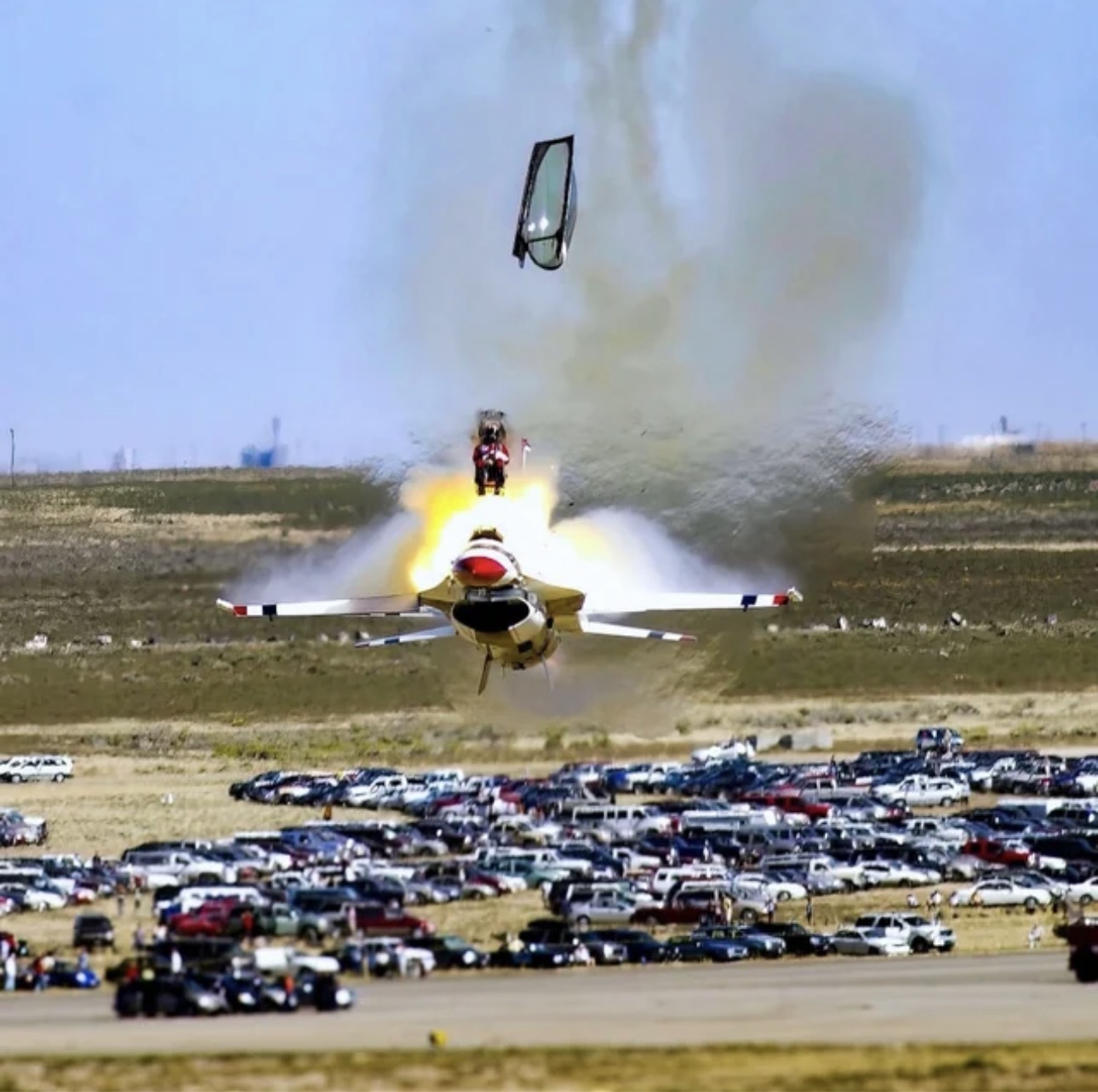
On September 14, 2003, an air show at Mountain Home Air Force Base in Idaho became the scene of one of the most dramatic emergency ejections in modern U.S. military aviation. Captain Christopher “Chris” Stricklin, a pilot with the U.S. Air Force Thunderbirds, was flying an F-16 Fighting Falcon during the Gunfighter Skies 2003 air show when a maneuver went disastrously wrong.
What made the accident especially remarkable was not simply that Stricklin survived. It was the fact that he remained with the aircraft until he had done everything possible to direct the crippled jet away from the spectators. Only after determining that the F-16 could no longer be saved did he activate the ejection system.
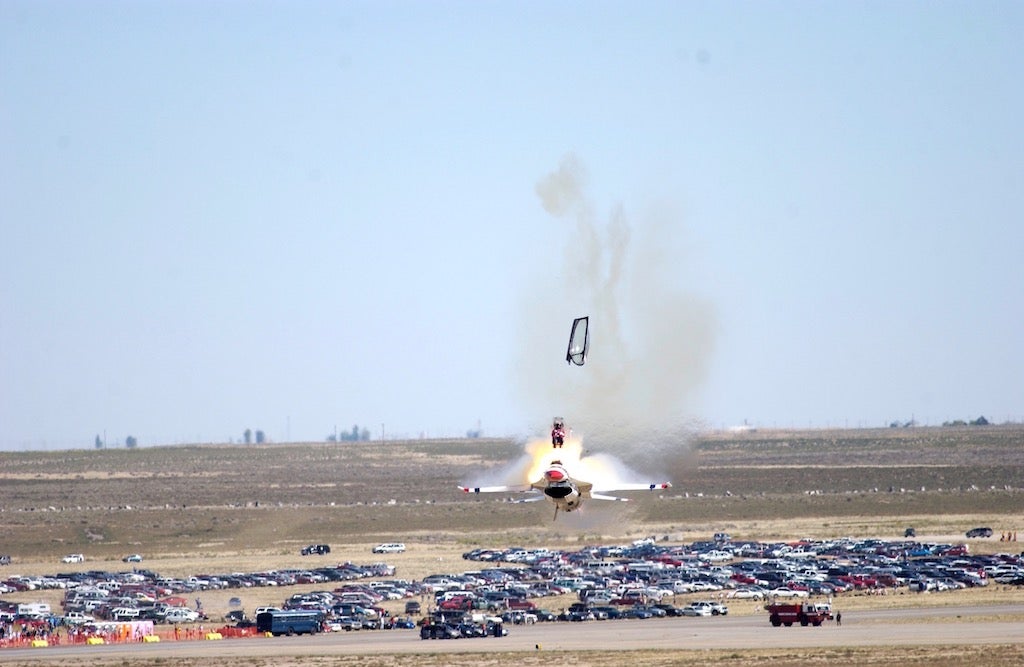
The aircraft ultimately struck the ground less than one second after Stricklin ejected. The official U.S. Air Force investigation reported that he was approximately 140 feet above the ground at the moment of ejection and that the aircraft was destroyed. Stricklin survived with only minor injuries, and no spectators or people on the ground were injured. (Air Force)
A Routine Air Show Maneuver Turns Into an Emergency
The U.S. Air Force Thunderbirds are famous for performing highly precise aerial demonstrations in front of large crowds. Their performances involve carefully rehearsed formations, rapid transitions, high-speed passes and maneuvers that leave pilots with very little room for error.
On that September afternoon, Captain Stricklin was flying Thunderbird No. 6, the team’s opposing solo aircraft. The aircraft was an F-16C Fighting Falcon, a single-engine multirole fighter designed for speed, maneuverability and demanding combat operations.
The demonstration was being performed before a crowd of more than 60,000 people. Shortly after takeoff, Stricklin began a maneuver known as the “Split-S.”
The Split-S is a descending maneuver in which the aircraft rolls inverted and then pulls through a descending half-loop. When performed at sufficient altitude, the maneuver can be completed safely. But at air-show altitudes, where the aircraft is deliberately kept relatively close to the ground for spectators, the available margin for error is extremely small.
The accident investigation later determined that Stricklin had misinterpreted the altitude required to complete the maneuver. He climbed to approximately 1,670 feet above ground level rather than the 2,500 feet required for the maneuver. (Air Force)
That difference of hundreds of feet became critical within seconds.
The Altitude Problem
The investigation found that the mistake involved the way altitude information was interpreted.
At air shows, pilots and ground personnel have to work with precise altitude information. The accident board found that the procedures then in use required demonstration pilots to convert between mean sea level and above-ground-level altitude information.
Mountain Home Air Force Base also had an important geographical difference from the Thunderbirds’ home base at Nellis Air Force Base in Nevada. The airfield’s elevation contributed to the potential for confusion when converting altitude figures.
The accident report concluded that Stricklin incorrectly calculated the altitude necessary to complete the maneuver. Instead of reaching approximately 2,500 feet above the ground, the F-16 began the maneuver from only about 1,670 feet.
Once the Split-S began, there simply was not enough altitude available to recover the aircraft.
This was not a situation where the pilot had minutes to analyze the problem. The entire sequence unfolded extremely quickly.
Realizing the Jet Could Not Be Saved
As the F-16 descended, Stricklin recognized that something was wrong.
The normal recovery path was no longer available. The aircraft was rapidly losing altitude, and the remaining distance between the jet and the ground was disappearing.
At this point, Stricklin faced two immediate priorities.
First, he had to attempt to recover the aircraft if recovery remained possible.
Second, if the aircraft could not be recovered, he had to make sure it did not crash into the spectators.
The second decision became crucial.
According to the Air Force investigation, Stricklin applied maximum back-stick pressure and rolled the aircraft slightly to the left. The purpose was to direct the F-16 away from the crowd in the event that an ejection became necessary. (Air Force)
This decision placed the aircraft on a path that reduced the danger to the thousands of people watching the demonstration.
A Decision Measured in Fractions of a Second
The most dramatic part of the incident came at the very end.
Stricklin did not immediately eject when he first realized the maneuver was unrecoverable. He continued attempting to influence the aircraft’s flight path.
That decision meant that the ejection occurred extremely close to the ground.
The official accident report states that Stricklin ejected at approximately 140 feet above ground level, only about eight-tenths of a second before the aircraft hit the ground. (Air Force)
The Air Force later described the event as an example of a pilot ejecting only after guiding the aircraft away from a crowd of more than 60,000 spectators and determining that he could no longer save the aircraft. (ACC)
Eight-tenths of a second is almost impossible to comprehend in normal human terms.
For comparison, the blink of an eye can take several tenths of a second. Stricklin’s final decision occurred within a fraction of the time required for a person to react to many ordinary events.
Yet the ejection system functioned correctly.
The ACES II Ejection Seat
The F-16 was equipped with an ACES II ejection seat. The system performed as designed, allowing Stricklin to escape the aircraft just before impact.
The Air Force reported that the seat performed flawlessly and that Stricklin was not seriously injured. (ACC)
Ejection seats are among the most important survival systems installed in modern fighter aircraft. They are designed to give pilots a chance to survive situations in which the aircraft itself cannot be saved.
However, ejection at extremely low altitude is inherently dangerous because there is very little time for the seat to propel the pilot away from the aircraft and for the parachute system to deploy.
Stricklin’s successful escape therefore represented not only a critical decision by the pilot but also the successful operation of the aircraft’s emergency system.
The F-16 Was Destroyed
The F-16 did not survive the accident.
The aircraft struck the ground and was destroyed. The Air Force estimated its value at approximately $20.4 million at the time. No other military or civilian property was damaged, according to the investigation. (Air Force)
The loss of the aircraft was significant, but the most important outcome was that no one on the ground was killed or injured.
At an air show, a fighter aircraft crashing into an area occupied by spectators could produce catastrophic consequences. The presence of tens of thousands of people meant that even a small deviation in the aircraft’s flight path could have dramatically changed the outcome.
Stricklin’s decision to steer the F-16 away from the crowd was therefore central to preventing a much larger disaster.
Why the Incident Became So Well Known
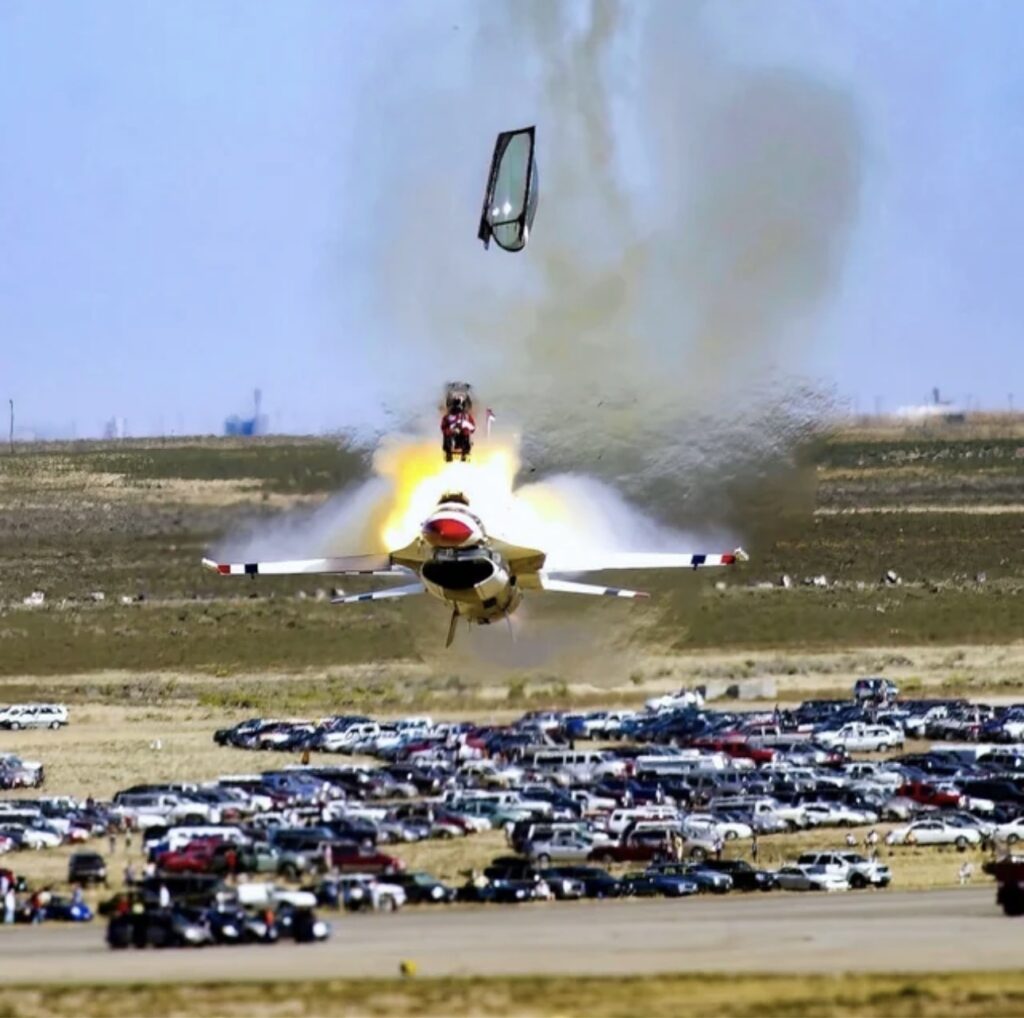
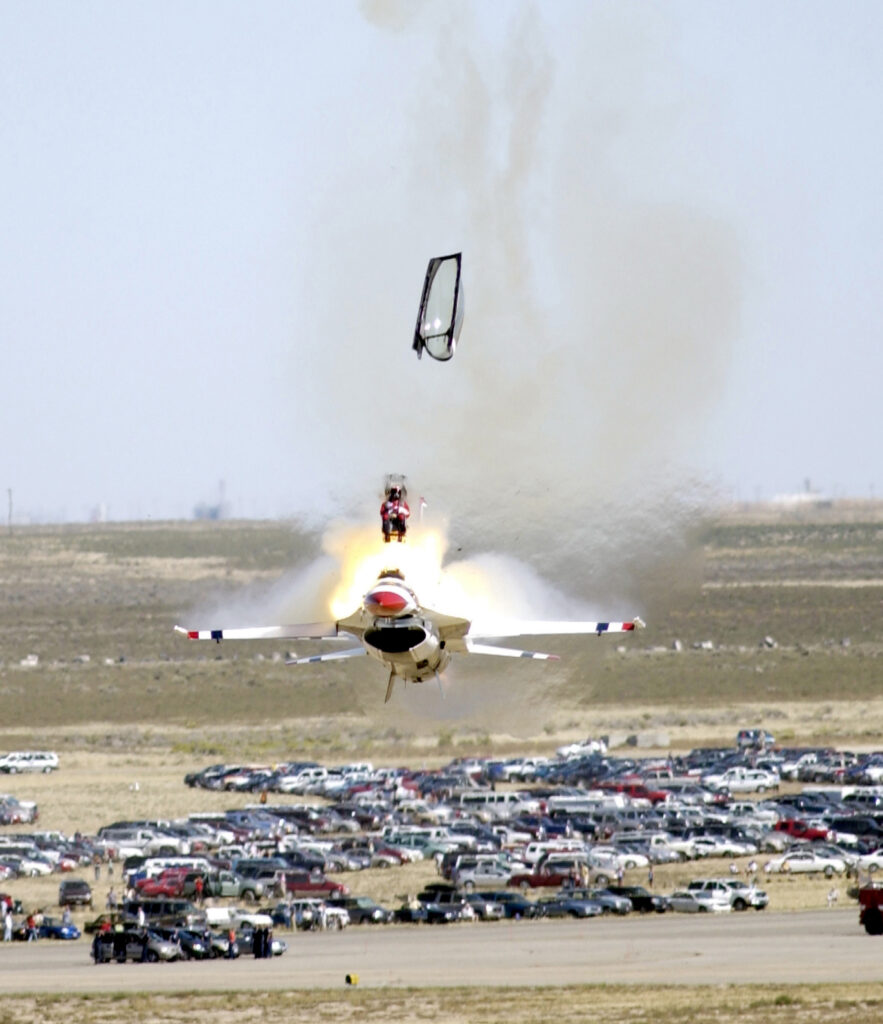
Images of the accident later became widely circulated because they captured an extraordinary moment: Stricklin visibly separating from the F-16 just before the aircraft struck the ground.
The U.S. Air Force released a photograph showing the pilot ejecting from Thunderbird No. 6. The official caption noted that he had first guided the aircraft away from the crowd before ejecting. (Wikimedia Commons)
The photograph became one of the most recognizable images associated with military aviation emergency procedures.
It demonstrates something that is difficult to appreciate from videos alone: fighter pilots sometimes have only seconds to make decisions that determine whether they survive.
In Stricklin’s case, the decision was also about more than his own survival.
The Investigation
After the crash, the U.S. Air Force conducted an accident investigation to determine what had caused the F-16 to descend into the ground.
The investigation concluded that pilot error was the primary cause. Specifically, Stricklin had misinterpreted the altitude required to complete the Split-S maneuver. (Air Force)
However, the investigators did not simply stop at blaming the pilot.
The accident board also identified systemic factors that contributed to the circumstances. These included the requirement for demonstration pilots to convert between mean-sea-level and above-ground-level altitude information, as well as the limited margin for error associated with the maneuver. (Air Force)
This distinction is important in aviation investigations.
A pilot may make the final mistake, but the environment, procedures, equipment, training and information systems surrounding that pilot can also influence the likelihood of an accident.
Lessons for Air Show Safety
The Mountain Home accident became an important example of how aviation organizations learn from mistakes.
Following the investigation, procedures for performing the Split-S maneuver were changed. The accident demonstrated the dangers of using different altitude references and relying on mental conversion during a maneuver with extremely limited recovery altitude.
The lesson was not simply “fly higher.”
It was about reducing ambiguity.
When a pilot is performing a complex maneuver at low altitude, there is little time to calculate or reinterpret information. Procedures need to make the correct action as clear and predictable as possible.
The accident therefore contributed to changes designed to reduce the possibility of similar altitude-reference errors in future Thunderbird demonstrations.
The Human Factor
One of the most interesting aspects of the Stricklin accident is the role of human decision-making.
A fighter pilot is trained to respond quickly to emergencies. But training does not eliminate the possibility of mistakes. Instead, it gives pilots tools for recognizing problems and responding to them.
In this case, Stricklin had to transition rapidly from an attempted recovery to emergency planning.
He had to recognize that the aircraft was not going to recover, determine where the jet was heading, consider the position of the spectators and then decide when ejection was unavoidable.
The Air Force reported that he used the remaining control authority to move the aircraft away from the crowd before ejecting. (ACC)
That sequence illustrates the enormous workload faced by demonstration pilots.
The Importance of the Crowd
An air show is fundamentally different from a normal military training flight.
In combat or training, an aircraft may operate over large areas where there are fewer people on the ground. At an air show, however, thousands of spectators are intentionally gathered near the flight demonstration area.
That means pilots must constantly consider not only their own aircraft but also the safety boundaries around the audience.
The official Air Force account specifically noted that Stricklin guided the aircraft away from more than 60,000 spectators before ejecting. (ACC)
The fact that the F-16 impacted away from the crowd was one of the most important factors in the outcome.
Survival Against the Odds
Stricklin survived the crash with only minor injuries.
The aircraft was destroyed, but the pilot walked away from an accident that occurred at an extraordinarily low altitude.
His survival was made possible by several factors working together: his recognition of the emergency, his control of the aircraft during the final moments, his decision to direct the jet away from the crowd, and the successful operation of the ACES II ejection seat.
The official Air Force record states that he was treated and released by military medical personnel after the accident. (Air Force)
More Than a Crash
It would be easy to describe the event simply as an F-16 crash at an air show.
But that description misses the most important part of the story.
The accident was a lesson in aviation risk management, human factors, emergency decision-making and the responsibilities of pilots operating in front of large crowds.
The investigation identified the altitude miscalculation as the primary cause, but the event also demonstrated how quickly a small error can become an emergency when a maneuver is performed close to the ground.
It also showed why aviation procedures are continually reviewed and modified after accidents.
A Last-Second Escape
On September 14, 2003, Captain Christopher Stricklin found himself with almost no time and almost no altitude.
His F-16 was descending toward the ground after an incorrectly calculated Split-S maneuver. Recovery was no longer possible. Yet before abandoning the aircraft, he continued to control it and directed it away from the spectators.
Then, at approximately 140 feet above the ground and only eight-tenths of a second before impact, he ejected. (Air Force)
The F-16 was destroyed.
Stricklin survived.
And the crowd of more than 60,000 people remained safe.
The incident remains one of the most striking examples of how quickly an air-show emergency can develop and how a pilot’s final decisions can dramatically influence the outcome. It also remains a powerful reminder that behind every spectacular military demonstration is a combination of precision, training, discipline and risk management.
For aviation enthusiasts, the image of Stricklin ejecting from Thunderbird No. 6 is unforgettable. But the deeper story is not simply about a dramatic photograph or a fighter jet crashing.
It is about a pilot recognizing that his aircraft could no longer be saved, using every remaining second to move it away from people, and finally choosing the moment when his own survival had to take priority.
The accident ultimately led to changes in procedures and reinforced an enduring principle of aviation safety: when an error occurs, the goal is not merely to determine who made the mistake, but to understand why it happened and how future accidents can be prevented.
Captain Christopher Stricklin’s 2003 F-16 crash therefore remains an important chapter in the history of the U.S. Air Force Thunderbirds—an extraordinary survival story, a sobering aviation lesson, and a dramatic example of the split-second decisions that military pilots sometimes have to make.
Sources
- U.S. Air Force, “Thunderbirds accident report released” — official accident-investigation summary. (Air Force)
- U.S. Air Force, “Thunderbird crashes at air show” — contemporary report on the September 14, 2003 accident. (Air Force)
- Air Combat Command, “Pilot ejects safely at air show” — official account of the ejection and crowd-avoidance action. (ACC)